
Ho Chi Minh City, June 29, 2026 – With only about 6 months remaining before the European Union Deforestation Regulation (EUDR) begins to apply to large enterprises, the Department of Crop Production and Plant Protection (Ministry of Agriculture and Environment) collaborated with the Vietnam Rubber Association and Forest Trends to organize "Consultation workshop on the draft guidelines for EUDR compliance in Vietnam's rubber industry". The workshop attracted participation from representatives of central and local management agencies, businesses, industry associations, international organizations, research institutes, and experts, aiming to finalize the guidelines before their official issuance.
Speaking at the opening of the workshop, Mr. Nguyen Quoc Manh, Deputy Director of the Department of Crop Production and Plant Protection, stated that since the EUDR was adopted by the European Union in 2023, Vietnam has implemented many activities to support various commodity sectors in adapting to the new regulation. In the cultivation sector, rubber and coffee are the two industries most significantly affected.
According to Mr. To Van Huan, Head of the Industrial Crops Division, Department of Crop Production and Plant Protection, in recent times, the Ministry of Agriculture and Environment has simultaneously implemented many solutions to adapt to EUDR, from raising awareness, building cultivation area databases, and enhancing international cooperation to developing technical guidance documents for each commodity sector. For the rubber industry, the draft guidelines are designed to assist stakeholders in the supply chain with implementing traceability, geo-locating cultivation areas, assessing risks, and providing due diligence as required by the EU market.
One of the most discussed topics at the workshop was the specific characteristics of Vietnam's rubber supply chain, where approximately 60% of the area belongs to smallholder rubber farms with over 260,000 small-scale producing households. This is a crucial link but also the area facing the most difficulties in standardizing land records, collecting data, and ensuring traceability.
Mr. Vo Hoang An, Secretary General of the Vietnam Rubber Association, argued that this particular characteristic requires the guidance document to be rooted in practical realities rather than merely interpreting EUDR regulations.
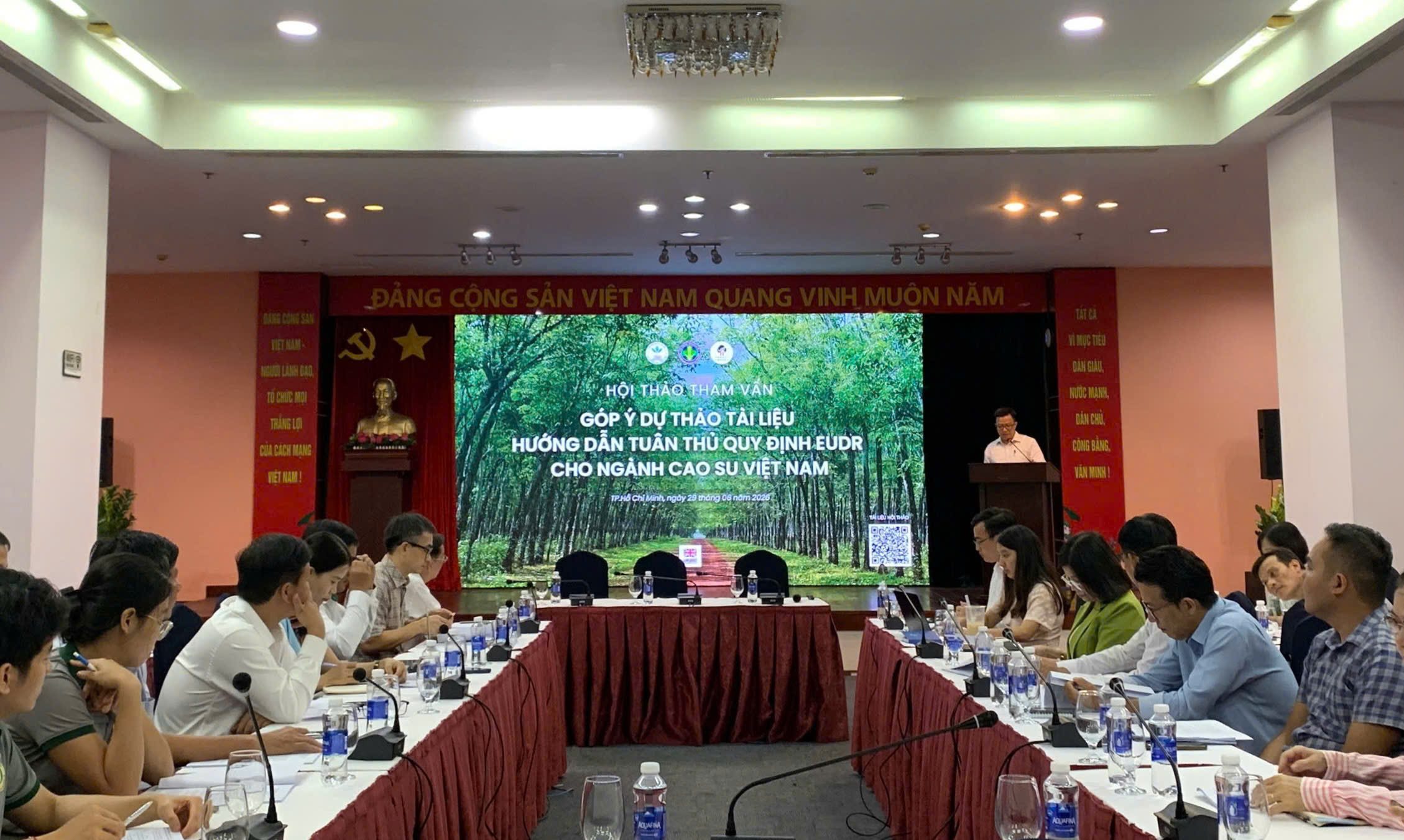
Photo 1: Overview of the workshop
Representatives from businesses, localities, and experts contributed many ideas to enhance the feasibility of the draft. Key topics of interest included standardizing terminology and concepts within the document; guidance on determining geo-coordinates and boundaries of cultivation areas; confirmation mechanisms by commune-level authorities; data sharing and security; management of raw materials purchased from smallholders; as well as procedures for updating data when there are changes in raw material areas. Many delegates also proposed adding illustrative examples, diagrams, and visual guides to assist users in practical implementation.
Mr. Truong Tat Do, a representative from the Department of Forestry - Forest Protection, also emphasized that in addition to the comprehensive guidance document, there is a need to develop simpler toolkits suitable for each target group in the supply chain.
Furthermore, many localities such as Dong Nai, Tay Ninh, Son La, and Dien Bien shared practical experiences and difficulties encountered in building cultivation area data, standardizing land records, and implementing traceability. Delegates agreed that finalizing the guidelines must go hand-in-hand with establishing data-sharing mechanisms, strengthening coordination among management agencies, businesses, and producers, and ensuring consistency with the general guidance framework of the Ministry of Agriculture and Environment.
Concluding the workshop, the organizing committee requested agencies, localities, businesses, and experts to continue submitting feedback before July 10, 2026 so that the drafting team can finalize the draft for submission and issuance in July.
The finalization and early issuance of the guidance document are expected to create a unified foundation for localities, businesses, and stakeholders in the rubber supply chain to uniformly implement EUDR requirements, thereby contributing to maintaining access to the EU market, enhancing traceability capabilities, and promoting the sustainable development of Vietnam's rubber industry.
No thoughts shared yet. Be the first to share your thoughts!