
Within the framework of the Forest Carbon Network supported by the UK PACT (UK Partnering for Accelerated Climate Transitions) Programme, the webinar “From 'Quantity' to 'Value': How Quality Affects Forest Carbon Credit Prices and Its Implications for Vietnam” attracted more than 80 delegates. The webinar featured three speakers: Ms. Nghiem Phuong Thuy – Specialist, Department of Science, Technology and International Cooperation, Vietnam Administration of Forestry; Prof. Dr. Pham Thu Thuy – Professor of Public Policy at Flinders University, and Adjunct Professor at the University of Adelaide, Australia; and Mr. Louis Booth – Asia-Pacific (APAC) Regional Director at Sylvera.
From a market perspective, Mr. Louis Booth emphasized that Vietnam's opportunity lies not just in generating credits, but in its ability to supply the right type of credits that international buyers need. According to him, Vietnam currently still primarily generates credits from renewable energy, while market demand is shifting; therefore, Vietnam needs to respond to supply the type of credits that international buyers desire more. He believes that when considering Vietnam's opportunities, two particularly important factors are quality and project type.
A point that Mr. Louis emphasized very clearly is the shifting trend between the voluntary and compliance markets. According to him, voluntary credits are credits used by businesses, individuals, or governments without a mandatory obligation; whereas compliance credits are where businesses or countries must use credits due to domestic system requirements or mechanisms like CORSIA. Notably, according to Sylvera's forecasting tool, by 2035, demand from the compliance market could be greater than demand from the voluntary market. He also noted that global voluntary demand will not increase sharply, while there remains potential to sell credits into compliance markets.
Mr. Louis also stated that the supply side is changing. Standards are becoming stricter, methodologies are being tightened, and technology, software, and forest monitoring data are being used to make project quality more understandable and predictable.
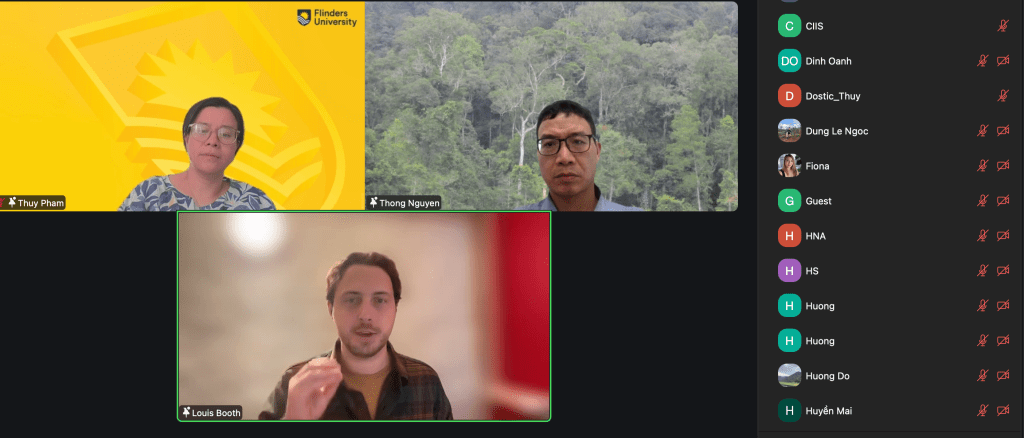
Photo 1. Prof. Dr. Pham Thu Thuy – Professor of Public Policy at Flinders University, and Adjunct Professor at the University of Adelaide, Australia (top row, left); Mr. Pham Trung Thong – Forest Trends (top row, right), Mr. Louis Booth – Asia-Pacific (APAC) Regional Director at Sylvera (bottom row).
From a state management perspective, Ms. Nghiem Phuong Thuy placed the above analyses into Vietnam's specific context. She stated that Vietnam has a large forest area, participated in REDD+ early, and has experience implementing emission reduction programs to generate credits. Ms. Thuy cited the example of the North Central Region Emission Reduction Program with FCPF, which issued 16.2 million credits, of which 11.3 million credits have been transferred, bringing in 56.5 million USD; concurrently, Vietnam is implementing the Central Highlands and South Central Coast emission reduction program to join the LEAF Coalition under ART-TREES standards.
Citing examples such as FCPF, LEAF, ART-TREES, Guyana, Costa Rica, Brazil, Ecuador, Nepal, and even the CORSIA mechanism, Ms. Thuy emphasized that for the same type of credit and the same type of project activity, prices can still vary greatly. She also stated that Vietnam is continuing to refine its policy framework related to the carbon market, from regulations on inventory, quota allocation, and registration systems, to policies on ITMOs and forest carbon sequestration and storage services. Based on this, she clarified that Vietnam needs a strategy for using forestry credits for which market: domestic compliance or international, ensuring both economic benefits and alignment with NDC and national emission reduction commitments.
From a research and market perspective, Prof. Dr. Pham Thu Thuy added that standards are not the only factor determining whether buyers purchase credits. According to her, in addition to standards, buyers also consider the number of credits available for sale, the selling price, political stability, as well as the ability to access buyers and market presence internationally. She also raised important questions about the true source of demand, competition among countries, the interaction between voluntary and compliance markets, as well as the cost-benefit analysis to achieve higher prices.
Responding to these discussions, Mr. Louis stated that for forestry credits, demand is still increasing, but quality is a key condition. According to him, forestry projects in Asia vary significantly in quality, and two prominent risks are low additionality and low permanence. Therefore, Vietnam needs to prioritize projects that truly require carbon revenue, have a long-term vision, and concurrently focus on the rights and benefits of communities and biodiversity. He emphasized that buyers will not want to fund a project that does not truly need carbon finance; and projects in Asia often fail on precisely two points: ensuring long-term permanence and additionality.
From the discussions at the webinar, a clear message emerged: Vietnam has significant opportunities in forest carbon development, but it will be difficult to translate these opportunities into real value if it only focuses on generating credits. The core is to correctly identify the target market and the type of credits that meet market demand; simultaneously understand buyer preferences, enhance project quality, strategically position Vietnam in the region, and fully calculate the cost-benefit equation, rather than just looking at the selling price.
No thoughts shared yet. Be the first to share your thoughts!