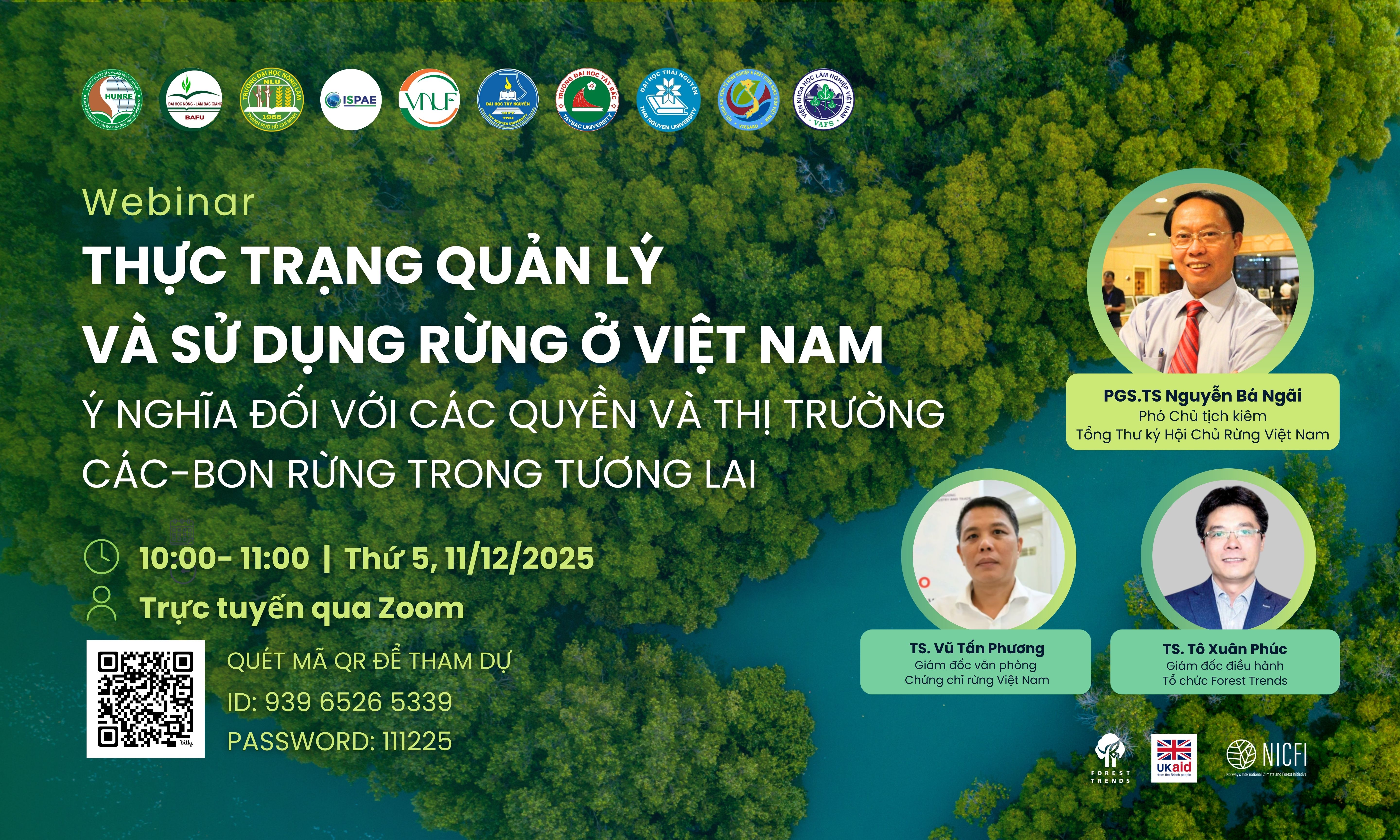
Vietnam is entering a phase of developing a national carbon market in line with the Government’s roadmap, while also expanding international cooperation mechanisms such as ERPA agreements and voluntary carbon markets. Against this backdrop, the question of forest carbon ownership has emerged as a critical legal bottleneck, directly affecting the ability to attract private investment, manage forest resources, and implement the country’s Nationally Determined Contribution (NDC). The webinar “Current status of forest management and use in Vietnam – Implications for future forest carbon rights and markets” held on 11/12/2025 provided an important forum to assess the current legal framework, identify gaps and challenges, and propose directions for improving regulations on forest carbon ownership and benefit-sharing.
The current legal framework on forest ownership and management: adequate for forests – not yet sufficient for carbon
According to Assoc. Prof. Dr. Nguyen Ba Ngai, Vietnam’s current legal system clearly establishes forest ownership rights, forest management rights, and the use of forestry land. However, it does not yet recognize forest carbon as an independent asset, a forest product under Article 2 of the Forestry Law, or as a “revenue or yield” under the Civil Code. The 2017 Forestry Law distinguishes two forms of forest ownership (state-owned and private) and three types of forest based on their purpose (special-use, protection, and production forests). However, as Dr. Vu Tan Phuong notes, Articles 2 (Clauses 10, 11, 16) and 7 of the Law make no reference to carbon, forest carbon, or carbon credits. This absence makes it impossible to determine the rightful owner of carbon sequestered or stored in forests under the Civil Code provisions on “revenue and yield,” since carbon is not a naturally occurring product formed without human intervention.
Practical experience from carbon project implementation confirms that carbon credits are only generated after meeting additionality criteria and completing measurement, reporting, and verification (MRV) requirements. Therefore, forest carbon cannot be considered a “revenue” in the legal sense; at most, it may be regarded as income derived from investment activities. However, current legislation does not provide clear provisions specifying who is entitled to this income within the chain of forest ownership and use rights. As a result, different localities and forest owner groups interpret the issue differently, creating legal uncertainties and risks in implementation.
Carbon ownership across forest tenure regimes: clarity in private plantations, ambiguity in natural forests
According to Assoc. Prof. Ngai, natural forests and plantation forests established with state investment are both under public ownership, with the State acting as the representative owner. Entities assigned to manage these forests—such as forest management boards, commune-level People’s Committees, and state-owned forestry companies—have management and use rights as prescribed by law, but cannot automatically be regarded as the owners of the carbon sequestered or stored in the forests. This situation leads to two key implications:
- Organisational forest owners only hold procedural rights, such as managing, supervising, and carrying out forest protection responsibilities;
- The State retains the authority to determine the allocation of carbon contributions toward the NDC and the right to transfer carbon credits at the national or provincial level.
In contrast, for the more than 3.3 million hectares of plantation forests that are not under public ownership, carbon rights have a clearer legal basis. Forest owners who invest their own capital have legitimate rights over the assets formed on the land and are proposed as the rightful owners of additional carbon generated, after fulfilling any required contribution to the NDC. This forest area is considered to hold the greatest potential for developing carbon projects. However, it still faces legal risks due to the absence of explicit regulations clearly defining ownership of carbon credits.
Expert view: legal uncertainty is directly constraining forest carbon investment
In the discussion session, Mr. Vu Tan Phuong – Director of VFCO – emphasised that no investor would commit to long-term investment in forest carbon projects without clarity on who owns the carbon credits generated. He noted that even the current draft Decree on forest carbon has yet to clearly determine:
- the ownership of carbon in each forest category;
- the position of forest carbon projects within the national NDC framework.
According to him, the main obstacle for natural forests lies in their status as “publicly owned.” National REDD+ programmes such as FCPF and LEAF have focused primarily on benefit-sharing mechanisms rather than clarifying ownership rights because these initiatives are designed to contribute to the national NDC, rather than to commercialise carbon credits. However, once the domestic carbon market is launched, enterprises are unlikely to participate without a clear legal framework guaranteeing their rights to control and transfer carbon credits.
Mr. Vu Tan Phuong issued a notable warning: “If the bottleneck surrounding carbon ownership is not addressed, we will not be able to mobilise social resources for forest protection and development. Relying solely on the state budget will not generate a breakthrough for the domestic carbon market.”
Policy implications: urgent requirements for strengthening the legal framework on forest carbon rights
From the analyses and discussions at the webinar, there were three key groups of policy implications:
(1) Clearly define and establish forest carbon rights within the legal system
Vietnam needs to strengthen its legal framework to clearly determine:
- carbon ownership rights across different forest categories and investment forms;
- the rights to control and transfer carbon credits;
- the relationship between carbon ownership rights and NDC contribution obligations.
(2) Recognise carbon credits as a distinct category of assets
Carbon credits should be clearly recognised as a form of property that can: (i) be owned, (ii) be controlled and disposed of, (iii) be traded, and (iv) be protected under the law. Failure to clearly recognise the proprietary nature of carbon credits will hinder transactions and capital mobilisation.
(3) Separate forest ownership rights from carbon ownership rights
The allocation of land and forests does not automatically entail the allocation of carbon rights. Therefore, it is necessary to:
- a mechanism for allocating carbon rights in publicly owned natural forests;
- a mechanism for recognising carbon rights for self-investing forest owners;
- a mechanism for transparent authorisation or benefit-sharing agreements with investors.
Conclusion
Comments and discussions at the webinar underscored that forest carbon rights are a central issue, determining both the operability of the national carbon market and the ability to attract private investment for forest protection and development. Although Vietnam possesses significant carbon sequestration potential, legal gaps concerning carbon ownership continue to hinder the effective formation of the carbon market.
Strengthening the legal framework on forest carbon rights—including clarifying ownership, recognising carbon credits as a form of property, and clearly separating forest ownership from carbon ownership—will play a pivotal role in transforming potential into tangible resources, serving both economic objectives and national emission reduction commitments.
No thoughts shared yet. Be the first to share your thoughts!