
On August 22, 2025, the U.S. President announced an accelerated tariff investigation under Section 232 of the Trade Expansion Act of 1962 on imported furniture. The purpose of this investigation is to determine whether such imports threaten U.S. national security. The investigation period has been shortened from 9 months to 50 days, and the U.S. government has just released the findings and the tariff rates, which will take effect on October 14, 2025. To help enterprises promptly access this information and assess its practical impacts, wood industry associations, in collaboration with Forest Trends, organized a webinar titled: “New U.S. tariff rates and their implications for Vietnam's wood product exports".
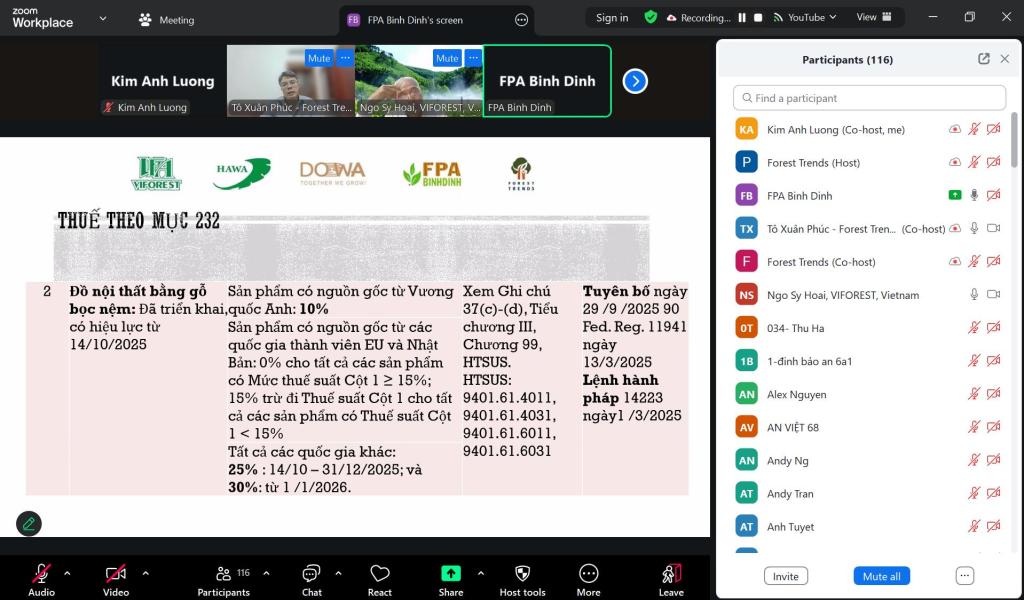
Speaking at the meeting, Mr. Tran Le Huy, Vice Chairman and Secretary General of the Binh Dinh Wood and Forest Products Association , said that on October 30, President Trump’s administration released the results of the Section 232 investigation on a range of products, including wood and wood products. Accordingly, starting October 14, 2025, a 10% tariff will be imposed on softwood and sawn timber, and a 25% tariff on upholstered wooden furniture, kitchen cabinets, vanities, and several other wooden items. Then, from January 1, 2026, the tariffs will further increase to 50% for kitchen cabinets and vanities, and 30% for upholstered furniture. Trading partners will have three months to negotiate specific tariff rates with the United States. In addition, Vietnam is currently subject to a 20% retaliatory tariff starting August 7 and may face tariffs of up to 40% if found to be transshipping goods originating from China.
Photo 1. The webinar attracted the interest of more than 100 participants from wood industry associations and enterprises.
Mr. Joseph Damond, trade policy expert and legal advisor at the Embassy of Vietnam in the United States shared that this investigation was driven by a number of U.S. domestic furniture manufacturers who claim that imported wooden products have harmed their interests and threatened jobs and the operations of American workers and businesses. Although they do not represent the entire U.S. wood industry—in fact, many large furniture companies import significant volumes from Vietnam and benefit from this supply chain—regulatory agencies within President Trump’s administration lack a clear understanding of the current structure of the furniture supply chain from Vietnam. Therefore, the Vietnamese government and enterprises need to urgently review and provide data and evidence in order to deliver a unified message that can persuade the U.S. government to reconsider this decision and issue rulings favorable to Vietnam.
Photo 2. Mr. Pham Quang Huy, Agriculture counselor under the Embassy of Vietnam in the United States

Mr. Pham Quang Huy, _Agriculture counselor under the Embassy of Vietnam in the United States_stated that this new order will not only affect Vietnamese enterprises but will also directly impact both American consumers and U.S. businesses. This is also an opportunity to promote cooperation between associations and enterprises of the two countries, while demonstrating Vietnam’s goodwill and commitment to complying with international regulations and standards, toward sustainable development. The Ministry of Agriculture and Environment has worked very closely with the U.S. side during the recent Section 301 investigation and will continue to collaborate with wood industry associations in both Vietnam and the United States in the time ahead. Mr. Ngo Sy Hoai, Vice Chairman and Secretary General of the Vietnam Timber and Forest Products Association (VIFOREST), said the association highly appreciates the timely actions taken by government ministries and agencies. VIFOREST has coordinated with the Vietnam Trade Office in the United States to hold meetings with several U.S. wood furniture associations to seek ways to respond to this order.
At the webinar, representatives of several major exporters to the U.S. market also shared information about the tariff rates that wood products exported to the United States are subject to.Mr. Vu Quang Huy – Director of Tekcom Joint Stock Company one of the largest plywood manufacturers and exporters in Vietnam—said that plywood is not subject to the Section 232 tariff order but is currently under anti-dumping investigation. If plywood is subjected to anti-dumping duties, those rates will be added on top of the existing 20% retaliatory tariff. The results of the anti-dumping investigation are expected to be announced at the end of 2025.
Photo 3,4,5 (from left to right): Mr. Vu Quang Huy, Director of Tekcom Joint Stock Company; Mr. Nguyen Ngoc Thanh, General Director of Thien Phat Co., Ltd; Mr. Nguyen Chanh Phuong, Deputy General Director of AA Corporation

According to Mr. Nguyen Ngoc Thanh – General Director of Thien Phat Co., Ltd — one of the major exporters of kitchen and bathroom cabinets to the U.S. market — in the coming period, Vietnam’s wood industry will face significant challenges due to the high risk of further investigations by the United States. Vietnam’s wood associations need to coordinate with relevant ministries and agencies such as the Ministry of Agriculture and Environment, the Ministry of Industry and Trade, etc., to step up communications with the U.S. government regarding the current state of the supply chain for wood products imported from Vietnam, so that these agencies clearly understand the benefits the United States gains from importing wooden products from Vietnam. The government needs to develop a comprehensive development strategy for the entire wood industry to ensure that processing sectors operate efficiently and harmoniously, and that sustainable input materials are secured. Currently, enterprises must independently struggle to adapt to market fluctuations, while support from ministries and agencies remains limited and ineffective. The number of workers in the wood sector affected by the Section 232 investigation will be very large. Therefore, the industry strongly hopes that the government will take timely action to minimize the negative impacts of this investigation.
Mr. Nguyen Chanh Phuong, Deputy General Director of AA Corporation, noted that the impact of the Section 232 investigation on the upholstered furniture segment is substantial. A Chinese-invested FDI enterprise producing sofas in Vietnam reported that up to 30% of its orders to the U.S. have been canceled. Issues related to Chinese FDI are highly sensitive in the context of the ongoing U.S.–China trade war. Associations and enterprises need to discuss very carefully to craft effective communication messages to the U.S. side. Understanding the domestic situation in the United States is crucial for Vietnamese businesses to stay informed and develop response strategies to changes in U.S. government policies and directions.
Photo 6,7(from left to right): Mr. Do Ngoc Hung, Head of the Vietnam Trade Office in the United States;
Mr. Dang Khanh Linh, Representative of the Embassy of Vietnam in the United States

Mr. Do Ngoc Hung, _Head of the Vietnam Trade Office in the United States_According to the United States Trade Representative (USTR), in principle, when tariffs are imposed under a Section 232 investigation, retaliatory tariff are not applied. Tariff rates will be adjusted for U.S. trading partners depending on the outcome of negotiations. According to statistics from the U.S. government, in the first seven months of 2025, Vietnam’s exports to the United States were very high, increasing by more than 40%. The trade surplus exceeded USD 100 billion, making Vietnam the largest exporter to the U.S. during this period and placing the country under special scrutiny. In the time ahead, not only the wood industry but also other sectors such as seafood, semiconductors, etc., will be greatly affected by U.S. domestic production protection policies. Enterprises and associations need to seek legal support from lawyers with extensive experience in investigations and anti-dumping lawsuits in the United States. Vietnam’s negotiating delegation will make every effort to engage with relevant parties to minimize tariff levels imposed on Vietnamese goods.
Mr. Dang Khanh Linh, Representative of the Embassy of Vietnam in the United States, noted that the U.S. primarily aims to protect its domestic manufacturing industries, and the main target of these actions is China. The U.S. has detected several shipments of Chinese furniture labeled as products of Malaysia. Although Vietnam has not been explicitly named, the U.S. government has repeatedly pointed out that exports of wood products from Southeast Asia have surged, while U.S. imports of wooden products from China have sharply declined since 2018. Vietnam has a major advantage, as it imports a significant volume of hardwood from the United States. Both short-term and long-term measures are needed to adapt to the political situation in the U.S. and sustain export capacity to this market. In the short term, stakeholders can step up communication efforts to help the U.S. government understand that the import supply chain from Vietnam is supporting the U.S. furniture industry, creating jobs, and bringing benefits to American consumers; continue increasing imports of raw wood from the U.S.; restructure domestic production to cope with pricing pressure from U.S. importers; and consider the possibility of investing in the U.S. market.
Forest Trends will continue to work closely with the Vietnam Timber and Forest Products Association, the Ministry of Agriculture and Environment, and associations in both Vietnam and the United States to collect and share information on U.S. tariffs on wood and wood products with the business community.
No thoughts shared yet. Be the first to share your thoughts!