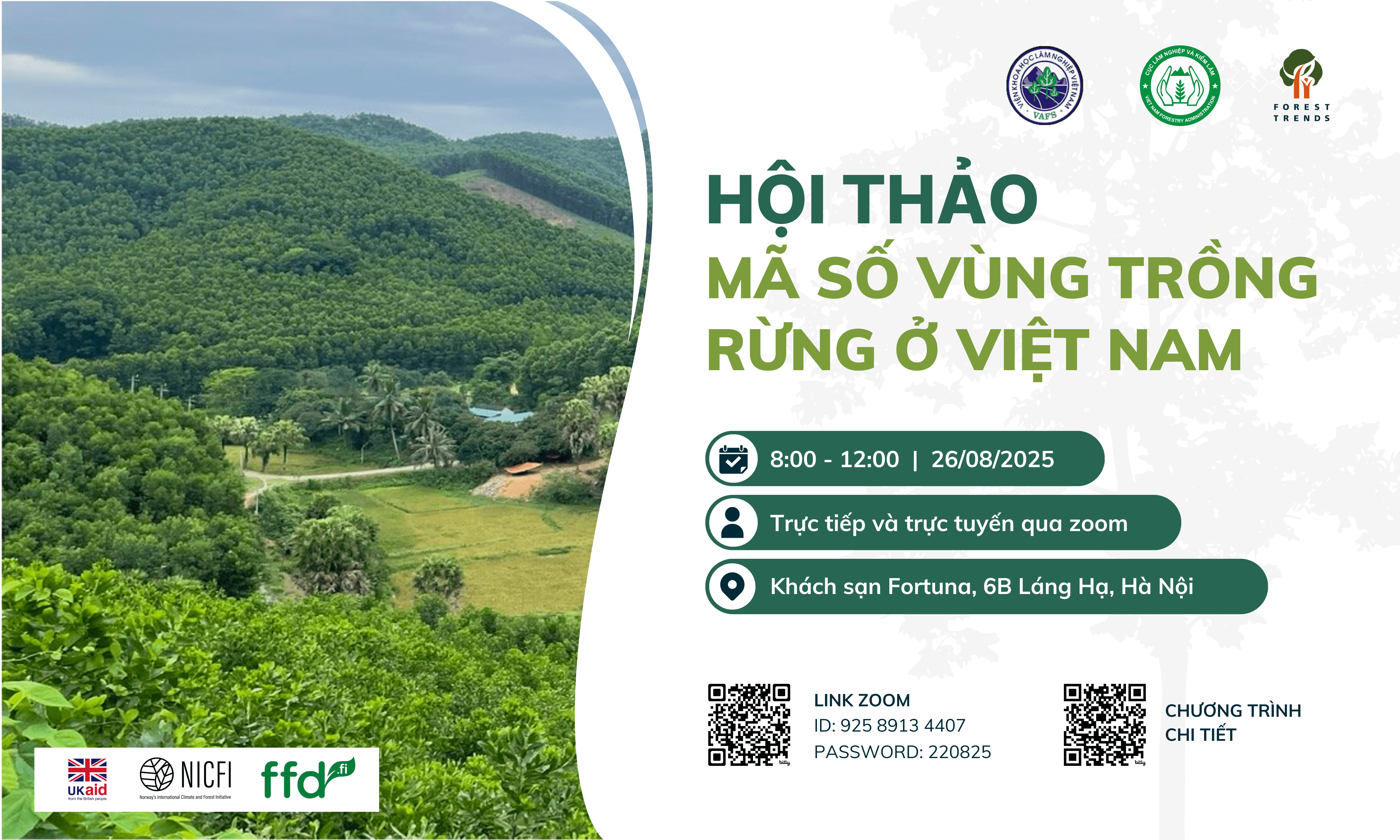
Ha Noi, 26/08/2025 –As international markets such as the European Union with its Anti-Deforestation Regulation (EUDR) and the U.S. Lacey Act tighten requirements for timber legality and traceability, identifying and digitizing data for each forest plantation plot has become a strategic mission for Vietnam’s forestry sector. The workshop “Forest Plantation Area Code in Vietnam,” co-hosted by the Department of Forestry, the Forest Protection Department, and the Forest Science Institute of Vietnam on August 26, 2025, focused on pilot results, achievements, and upcoming directions in the management and application of the Forest Plantation Area Code (FPAC).
Forest Plantation Area Code – the “Birth Certificate” of a Forest Plot
According to Associate Professor Dr Nguyen Ba Ngai, the FPAC pilot in five provinces has reached 25,915 hectares—exceeding the original plan—with more than 20,000 plots identified. More than a technical code, FPAC is seen as the “birth certificate” of each plantation plot, containing comprehensive information on forest owners, land use rights, geographic coordinates, and forest conditions. Integrated into digital platforms, FPAC enables traceability that is “reliable, real-time, updated, and efficient,” aligning well with EUDR requirements and key export markets.
Local Experience – Opportunities and Challenges
In Bac Giang, Yen The Forestry Company—one of the pilot units—has been granted FPAC for more than 1,900 hectares. Deputy Director Nguyen Van Nhat emphasized: “Applying FPAC allows us to manage forest area and volume more accurately, while also creating a competitive advantage, as some international buyers are willing to pay 3–5% more for timber with verified traceability.”
From Tuyen Quang, Deputy Head of the provincial Forest Protection Sub-Department, Trieu Dang Khoa, highlighted that assigning codes has initially enhanced timber transparency and export opportunities. After one year of implementation, the province has issued FPAC for 5,473 hectares of plantations with 4,858 codes, mainly for acacia and eucalyptus forests. However, the pilot has also revealed challenges. For households, providing land use documentation remains a major obstacle. For forest rangers and local authorities, the workload has increased significantly without clear legal provisions on responsibility and functional mandates.
Mr Khoa added: “Some forest owners are not fully enthusiastic because the economic benefits are not immediately visible. Meanwhile, databases are still fragmented, and IT infrastructure in rural areas has yet to meet the requirements.”
Forest Plantation Area Code – A missing piece for EUDR and legal timber management
Experts affirmed that the FPAC has proven to be a vital missing piece complementing two existing mechanisms: the Vietnam Timber Legality Assurance System (VNTLAS) and the implementation of the EUDR. With FPAC, Vietnam’s legal timber supply chain will become more transparent, helping businesses access international markets more smoothly.
Next Steps: Full Digitalization and Legal Framework Development
Concluding the workshop, Tran Quang Bao, Director General of the Department of Forestry and Forest Protection, stressed: “FPAC is an essential step to identify the entire plantation forest area, integrate it into the national digital database, and meet timber traceability requirements for global markets. Moving forward, the sector will continue developing the system in alignment with Project 06 on land and forest database building, aiming for electronic management, QR coding, and full-sector connectivity.”
He also underlined that FPAC is not a replacement for sustainable forest certifications such as FSC or PEFC, but a complementary tool for legality and traceability, particularly for households and smallholders. The next priority is to finalize the legal framework, scale up nationwide implementation, and integrate it into forestry digital transformation.
The workshop reaffirmed FPAC’s pioneering role in preparing Vietnam to meet international standards while strengthening forest governance and timber supply chains. With joint efforts from regulators, businesses, and communities, FPAC is set to become a key instrument driving transparency, sustainability, and deeper integration of Vietnam’s forestry sector into global value chains.
No thoughts shared yet. Be the first to share your thoughts!