
Hanoi, August 15, 2025 – The Vietnam Administration of Forestry (VNFOREST) and the Forest Protection Department have completed a series of three regional and national consultation workshops on the Draft Decree regulating forest carbon absorption and storage services, held from July 11 to August 15, 2025. The events were organized to gather comprehensive feedback from 64 provinces nationwide, ensuring the draft aligns with the current legal system, approaches international practices, and is highly feasible, especially as Vietnam intensifies its commitment to achieve Net Zero emissions by 2050 made at COP26.
In the context of climate change being a global challenge, Vietnam is among the most severely affected nations and has demonstrated strong commitments at COP26 to achieve "Net Zero" emissions by 2050. The forestry sector holds a particularly crucial role, not only in carbon absorption and storage but also in economic and social development, environmental protection, and climate change response. Currently, Vietnam only has one pilot agreement, the North Central ERPA with the World Bank under Decree 107/2022/NĐ-CP, while also preparing to negotiate an emissions reduction agreement for the Central Highlands and South Central regions with Emergent. Therefore, the drafting of this Decree, which concretizes the provisions of the 2017 Law on Forestry and the 2020 Law on Environmental Protection, creates a transparent legal corridor for forest carbon services—a service considered key to climate change response and forest-based economic development—is a strategic step for Vietnam's forestry sector.
Pursuant to Resolution No. 01/NQ-CP dated January 8, 2025, Viet Nam Forestry Administration (VNFOREST) were assigned to lead the development of the Decree on Forest Carbon Absorption and Storage Services. With support from the UN-REDD Programme and Forest Trends, the three consultation workshops for 64 provinces nationwide were organized from July 11 to August 15, 2025. The goal was a comprehensive consultation on both the draft Decree and the draft Forest Carbon Standard, ensuring consistency with existing law, alignment with international norms, and practical feasibility. Two regional workshops were held in Thai Nguyen and Binh Dinh (now Gia Lai) provinces, and one national workshop in Hanoi. The series of workshops attracted the direct participation of over 300 delegates from Departments of Agriculture and Environment, provincial Forest Protection and Development Funds, National Parks, and technical experts. The National Consultation Workshop in Hanoi alone recorded over 700 online viewers, demonstrating deep interest from stakeholders.
Photo 1. The panoramic and group photo of the consultation workshops in Thai Nguyen, Quy Nhon and Hanoi
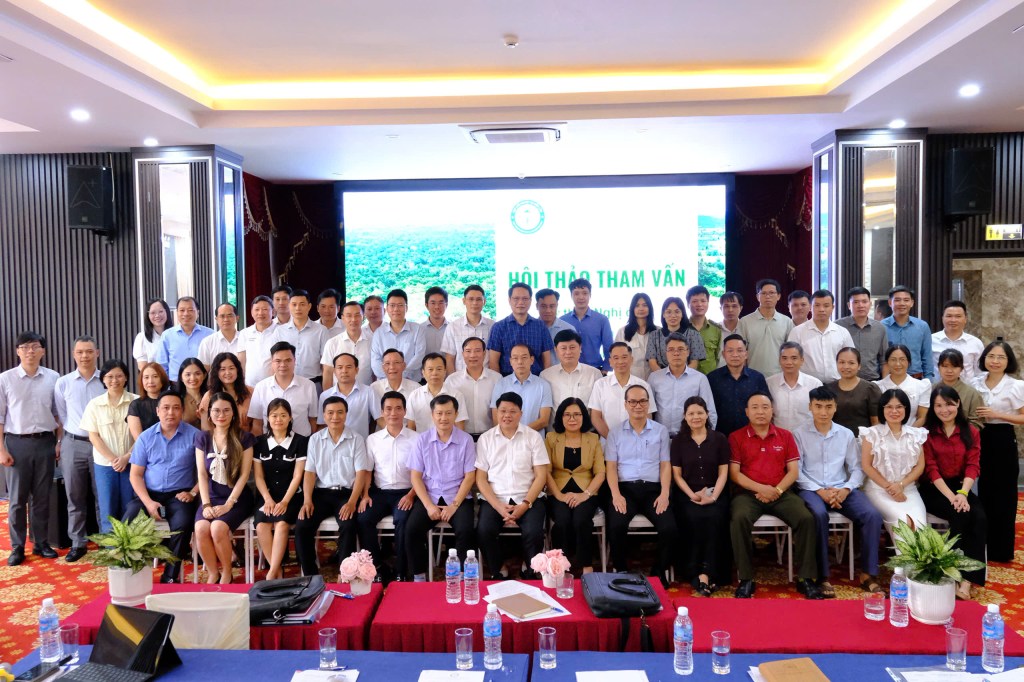
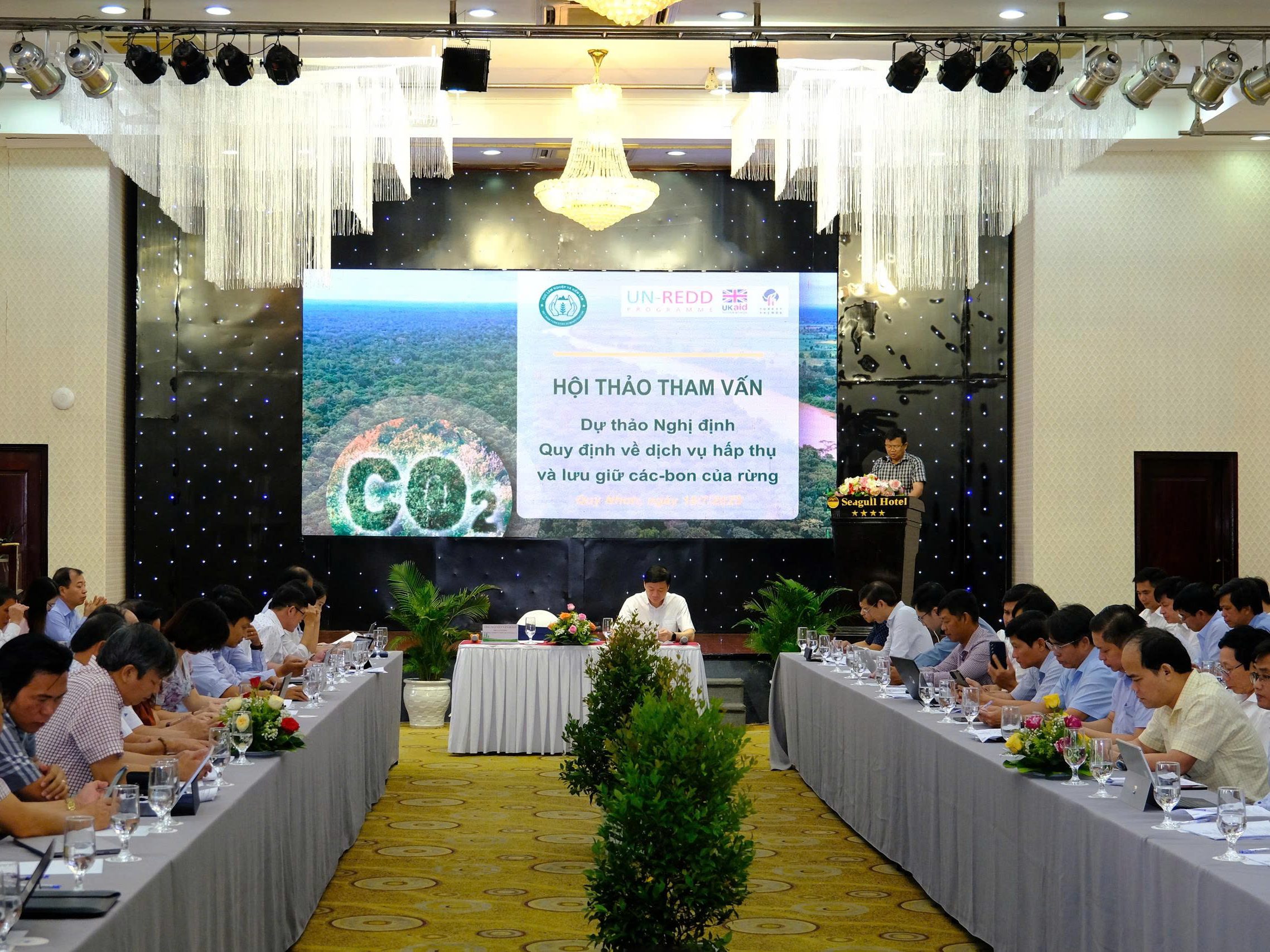
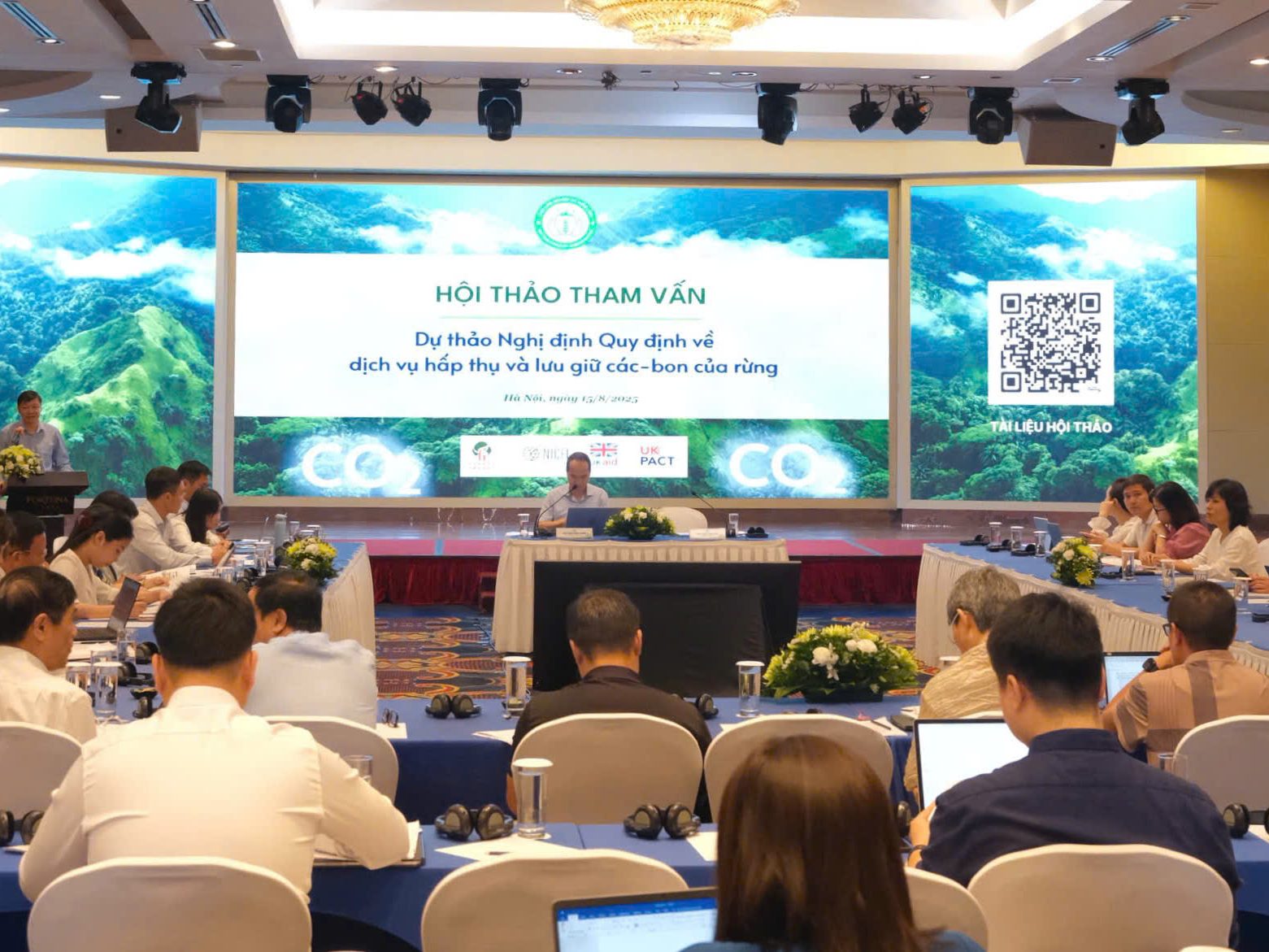
Photo: Forest Trends
The Draft Decree consists of 4 chapters, 20 articles, and 7 appendices, which stipulate principles, conditions, scope, forms, and payment levels. It also provides methodologies for determining emissions reductions and carbon credits, as well as the mechanism for managing and utilizing revenue from this service. The general principles are set as publicity, transparency, harmonized benefits, no impact on international commitments, and encouragement of investment cooperation in forest carbon projects.
Parallel to finalizing the Decree, the draft National Standard for Forest Carbon Credits was also presented for consultation. It outlines the technical requirements for five project types: Reducing Emissions from Deforestation and Forest Degradation (REDD+), Afforestation/Reforestation (A/R), Improved Management of Poor Natural Forests (IFM-N), Improved Management of Planted Forests (IFM-P), and Agroforestry (AFP). Projects must possess legal rights to manage the forest or land, have clear boundaries, ensure additionality, and avoid negative environmental or social impacts. Technically, projects must comply with regulations on forest protection, management, and development; follow IPCC guidelines for measurement and reporting; and be validated/verified by an independent organization meeting the ISO 14065:2013 standard. The draft also emphasizes ensuring social-environmental safeguards, respecting community rights, improving working conditions, and encouraging stakeholder participation.
The discussion sessions revealed deep interest in the Draft Decree. Many delegates proposed further clarification on the legal framework for carbon rights, especially for state-owned forests, and recommended adding specific provisions on the benefit-sharing mechanism and methods for determining price, and auctioning forest carbon credits with a transparent pricing framework and a unified floor price nationwide. Current regulations, such as those on auctioning forest lease rights, were noted as needing consideration. Experiences from international pilot projects in provinces like Tuyen Quang and Quang Nam highlighted high costs and complex procedures as major barriers, often leading to projects failing to generate anticipated carbon credits. Consequently, delegates proposed more flexible adjustment of project participation conditions and careful consideration of the percentage of revenue allocated for Measurement, Reporting, and Verification (MRV) and project implementation.
Other opinions suggested clarifying the decentralization of roles in project and expenditure approval, particularly the role of the commune-level People's Committees (PC). This would allow commune PCs to participate in carbon projects with appropriate scale and capacity, ensuring feasibility. Attracting private investors to state-owned forest projects was also raised as a topic requiring a clearer mechanism, going beyond the current scope of mere "encouragement."
At the National Consultation Workshop, delegates acknowledged that the latest version of the Draft, following regional consultations, showed clear progress: expanding the role of the private sector; adding a cooperation-linkage mechanism with a specific contract and appendix template for forest carbon projects; and clarifying the responsibilities of management agencies and the result/credit validation process. Furthermore, the draft proposes two transaction pathways (via contract and via exchange) to mobilize resources while the domestic market infrastructure is still developing, with the expectation of creating a transparent, feasible foundation for MRV and attracting social finance.
However, several issues still require clarification. Many comments focused on the method for allocating and updating NDC obligations and the conditions for approving international transactions to ensure only surplus credits are transferred after meeting national commitments. Regarding the pricing mechanism, proposals included clarifying the roles of different management levels, shortening the appraisal time, and considering consultation with an independent third party. On cooperation-linkage, concerns were raised about the formality of establishing a Coordination Board (as required by investment law), alongside proposals to adjust beneficiaries and the allocation formula to increase the weight given to emissions reduction results. Other feedback stressed the need for early issuance of MRV regulations, a disaster risk governance mechanism, and ensuring long-term sustainability to prevent credit double-counting. Some also recommended implementing a short-term pilot mechanism and developing a concrete impact scenario one year after issuance to build confidence and ensure practical feasibility.
The Draft Decree is expected to be finalized and submitted to the Government soon. Pilot programs—such as the North Central ERPA with the World Bank and the planned negotiations for an emissions reduction agreement in the Central Highlands – South Central region—will continue to provide a basis for practical lessons learned before the domestic carbon market operates synchronously under Decree 119/2024/NĐ-CP. This is considered a crucial preparatory step to both create new financial resources for the forestry sector and ensure the fulfillment of Vietnam's NDC obligations and the Net Zero 2050 commitment.
No thoughts shared yet. Be the first to share your thoughts!