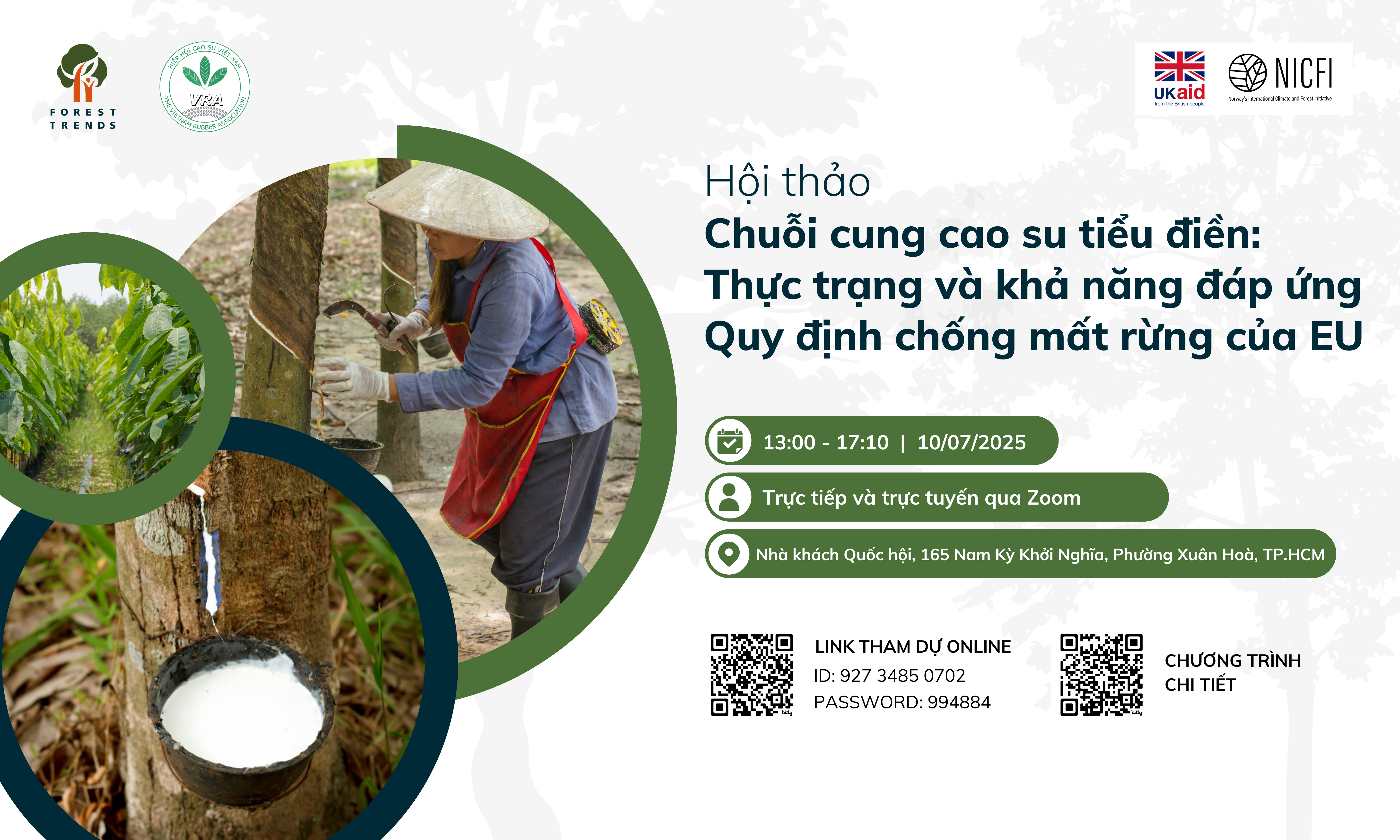
On July 10, 2025 in Ho Chi Minh City, the Vietnam Rubber Association (VRA) and Forest Trends Organization jointly organized the Workshop "Smallholder rubber supply chain: Current status and ability to meet the Union's Anti-Deforestation Regulations Europe"with the goal of increasing understanding of the smallholder rubber supply chain, helping Vietnamese rubber industry businesses and stakeholders prepare to meet EUDR requirements. The workshop provided information about EUDR Regulations and the current status of Vietnam's smallholder rubber supply chain, including a number of linkage models that have been implemented to adapt to EUDR. The workshop also proposed solutions to fully meet EUDR regulations for smallholder rubber supply chains in particular, and sustainable development of Vietnam's rubber industry in general in the future. The workshop attracted the participation of representatives of agencies under the Ministry of Agriculture and Environment, including the Department of International Cooperation and the Department of Crop Production. The conference also had the presence of Vietnam Rubber Industry Group, businesses producing, processing, importing and exporting rubber products, rubber agents and smallholders, technology companies, research agencies, international organizations and press agencies.
Photo 1: Mr. Nguyen Quoc Manh - Deputy Director of the Department of Crop Production and Plant Protection opened the conference with Mr. Vo Hoang An - Vice President, General Secretary of the Vietnam Rubber Association and Mr. Nguyen Vinh Quang - expert of Forest Trends organization

Source: Forest Trends
The rubber manufacturing and processing industry is one of Vietnam's most important export industries. In 2024, the country's total rubber planting area will reach nearly 910 thousand hectares, of which the area belonging to households (also known as small rubber farmers) accounts for 54%, and the area belonging to businesses accounts for 46%. Smallholder rubber is increasingly becoming an important source of raw materials for the industry. The area of smallholder farms has gradually increased over the years and officially surpassed the area of large landholdings since 2017. In 2024, the supply of raw rubber from farmers will reach 819 thousand tons of latex, equivalent to 63% of the total 1.3 million tons (dry) of raw materials in the country. The supply of rubber from smallholders is expected to continue to be stable in the coming years.
The European Union (EU) has issued the Regulation on Zero Deforestation and Forest Degradation (referred to as EUDR) from 2023, and will officially be applied from December 30, 2025. EUDR requires 7 product groups, including rubber, when imported into the EU, to ensure that (a) the entire supply chain - from production to export - complies with the laws of the country of production, has full traceability, and (b) the production process does not cause deforestation and forest degradation after December 31, 2020.
However, the rubber supply chain from smallholders is extremely complex, the operation of the chain is difficult to ensure traceability. In Vietnam, this supply chain mainly operates spontaneously, with the participation of 264 thousand smallholder households, along with many levels of intermediary agents who have the role of connecting households and processing enterprises, but lack a traceability control mechanism. In the current smallholder rubber supply chain, most farmers do not have records of production activities, and legal information about land is incomplete. At the same time, intermediary agents do not systematically store transaction records, and some agents even operate without business registration. This makes it extremely difficult to prove the legality and deforestation of products at the end of the chain. To meet EUDR requirements and maintain the ability to export to the EU market, intervention measures are needed to reorganize the supply chain from latex exploitation to production and export. Besides the EU, many other markets also require traceability such as the US, Japan, and Korea. Even China - the largest market accounting for 70% of Vietnam's rubber export turnover - has gradually tightened this regulation in recent years for agricultural and forestry products imported into this country. It can be said that this is a global trend and the Vietnamese rubber industry is forced to change to adapt if it wants to maintain and develop in the future.
Photo 2: Mr. Do Khac Toan, representative of Toan Huyen rubber dealer, shares his experience in implementing EUDR.

Source: Forest Trends
Mr. Do Khac Toan, Toan Huyen rubber dealer shared: “With EUDR, we have deployed about 40%, but it is very difficult because rubber grown on reclaimed forest land much, some pieces no books. If so, it is really difficult for people to provide information if they are not relatives. Many smallholders are still worried and wonder if the information will be leaked or sold to third parties. We hope that departments and agencies can send down official dispatches with clear and specific commitments and instructions in each locality to ensure and give people peace of mind.”
Vietnam has currently been forming large and small rubber plantation models to meet the EUDR. Enterprises that meet the EUDR are mainly enterprises belonging to the Group. Smallholder models responding to EUDR are mainly initiatives of private enterprises, such as models of Mai Vinh, Viet Sing, Thuan Loi, etc. implemented through linking smallholders and agents, supply chain organizations to ensure traceability and meet EUDR requirements for legality and not causing deforestation. Product “rubber meets EUDR” These models have been exported to the EU at prices 150 to 300 USD/ton higher than conventional products. “Market demand in the future is very large. We will expand production scale to meet the future market.” – Ms. Dang Thi Hoa Mai, Director of the company shared.
Photo 3: Mr. Mai Van Thoi - Representative of Mai Vinh company shares about his business's experience in meeting EUDR.

Source: Forest Trends
Dr. To Xuan Phuc, Director of the Forestry Policy, Trade and Finance Program of the Forest Trends Organization, said that processing enterprises need to play a role in promoting the formation of sustainable smallholder supply chains, especially private enterprises. "The supply of raw rubber from smallholders plays an important role not only for private enterprises but also for State-owned enterprises. The cooperation of businesses to support smallholders in meeting the requirements of supply chain transparency and sustainability should be a basic component of the business model of enterprises, in order to build long-term raw material areas and a controlled and sustainable supply chain," Dr. To Xuan Phuc expressed his opinion.
Mr. Vo Hoang An, Vice President and General Secretary of the Vietnam Rubber Association (VRA) emphasized: “Requirements for traceability and transparency in the supply chain are increasingly becoming mandatory standards in international markets. In that context, the smallholder rubber supply chain - which is the foundation of Vietnam's rubber industry and is closely linked to the livelihoods of hundreds of thousands of households - is facing the risk of being excluded from the global value chain if there is no appropriate support solution. Meeting the EUDR is a big challenge, but at the same time also is an opportunity to upgrade the entire value chain in a more sustainable and responsible direction. VRA will continue to accompany businesses, smallholders and stakeholders to promote a transparent supply chain model, consistent with world market trends.i.”
Mr. Nguyen Quoc Manh, Deputy Director of the Department of Crop Production and Plant Protection (VPD), Ministry of Agriculture and Environment (MARD) shared: "The Department determines that traceability is the core of EUDR. The traceability is conducted by businesses themselves. Many businesses are qualified to build their own databases, but there are still businesses that are not capable. The Department of Information and Plant Protection aims to build a database and software that all businesses can use. To use this software, businesses must coordinate with farmer households to declare. Currently, the database is being digitally converted by the Department. Assessing data security and safety. After that, businesses can use it completely free of charge. The Department of International Cooperation will also soon have a general guideline on EUDR sent to businesses and people. The collective efforts of all of us up to this point have been relatively successful, the EU has recognized Vietnam's efforts, through our inclusion in the low risk group.
Photo 4: Delegates discussed existing issues and solutions to improve the ability of smallholder supply chains to meet EUDR

Source: Forest Trends
Traceability, sustainable production, or meeting EUDR are indispensable activities for Vietnamese rubber enterprises. To do this, trust between links in the supply chain, between smallholders, agents or businesses plays a very important role. Most businesses still do not work directly with smallholder households. To be able to successfully meet EUDR, businesses need to have specific interactions to build trust between parties, share responsibilities, and support agents and farmers. Besides, technological support is essential to store and share information between links. In addition, stakeholders need different incentive mechanisms, as well as sanctions to promote more serious implementation. The Vietnamese government is currently actively implementing regulations on traceability and sustainable development in many fields from July 1, 2025. This is also an opportunity for Vietnam's rubber industry to transform by taking advantage of support from the government, local authorities and relevant parties to enhance legality and sustainability in the supply chain. Forest Trends will continue to coordinate with VRA, ministries and agencies to promote necessary support for farmers and agents to meet EUDR in particular and the increasingly strict requirements of export markets in the coming time.
For further information contact Ms. Luong Kim Anh (Email: kanh@forest-trends.org; Phone: 0703014431).
No thoughts shared yet. Be the first to share your thoughts!