City. Ho Chi Minh, June 19, 2025_ The European Union (EU) has issued the Anti-Deforestation Regulation (EUDR) to deal with deforestation caused by commodity crop production. This regulation applies to 7 product groups, including rubber, officially taking effect from December 30, 2025. According to EUDR, these products when exported to the EU must ensure that (a) all activities in the supply chain from production to export must meet all requirements of the producing country, ensuring traceability and (b) the production process does not cause deforestation.
The rubber industry is one of Vietnam's important export industries. In 2024, the export turnover of raw rubber and rubber products will reach nearly 8.5 billion USD. The EU is the industry's third largest market, with export turnover in the same year reaching 627 million USD (7.4% of total turnover). China is the industry's largest consumer market, with 2024 turnover from this market reaching 2.6 billion USD (30.3% of total turnover), mainly from natural rubber products. Here, a quantity of natural rubber originating from Vietnam is processed and exported to the EU as final products.

Photo 1: Workers harvesting rubber latex at Dong Phu Rubber Company, Binh Phuoc. Source: Forest Trends
Raw material supplies for Vietnam's rubber industry include domestic and imported sources. Vietnam currently has nearly 910 thousand hectares of rubber, 55% of which is from smallholder households (about 264 thousand households). The remaining 420 thousand hectares are large rubber plantations, mainly the area of enterprises belonging to the Vietnam Rubber Industry Group. In 2024, supply from smallholders accounts for 63% of the total 1.3 million tons of domestic raw rubber, with the remaining 37% of supply coming from businesses.
Imported supply, mainly from Cambodia and partly from Laos, plays a particularly important role in the industry today. In 2024, Vietnam imports nearly 620 thousand tons of natural rubber from Cambodia (56% of total imports) and 190 thousand tons from Laos (17%). This imported supply is mixed with domestic supply, processing and export flows. Import volume from Cambodia and Laos tends to increase. This shows the industry's increasing dependence on supply sources in neighboring countries. “Meeting the EUDR requires the Vietnamese rubber industry to strictly control imported supply, ensuring traceability to the farmland plot for this supply.” – emphasized Dr. Nguyen Vinh Quang, research expert of Forest Trends.

Photo 2: Workers are producing rubber in the factory. Source: Forest Trends
Vietnam has currently been forming large and small rubber plantation models to meet the EUDR. Enterprises that meet the EUDR are mainly enterprises belonging to the Group. Smallholder models to meet EUDR are mainly initiatives of private enterprises, such as the models of Mai Vinh Company, Viet Sing, Thuan Loi, implemented through linking smallholder households and agents, organizing the supply chain to ensure traceability and meet EUDR requirements for legality and not causing deforestation. Product "Rubber meets EUDR” from these models were exported to the EU at prices higher than conventional products from $150 to $300/ton. “Market demand in the future is very large. We will expand production scale to meet the future market.” – Ms. Dang Thi Hoa Mai, Director of the company shared.

Photo 3: Representative of Mai Vinh Rubber Company shares about the smallholder rubber model here. Source: Forest Trends
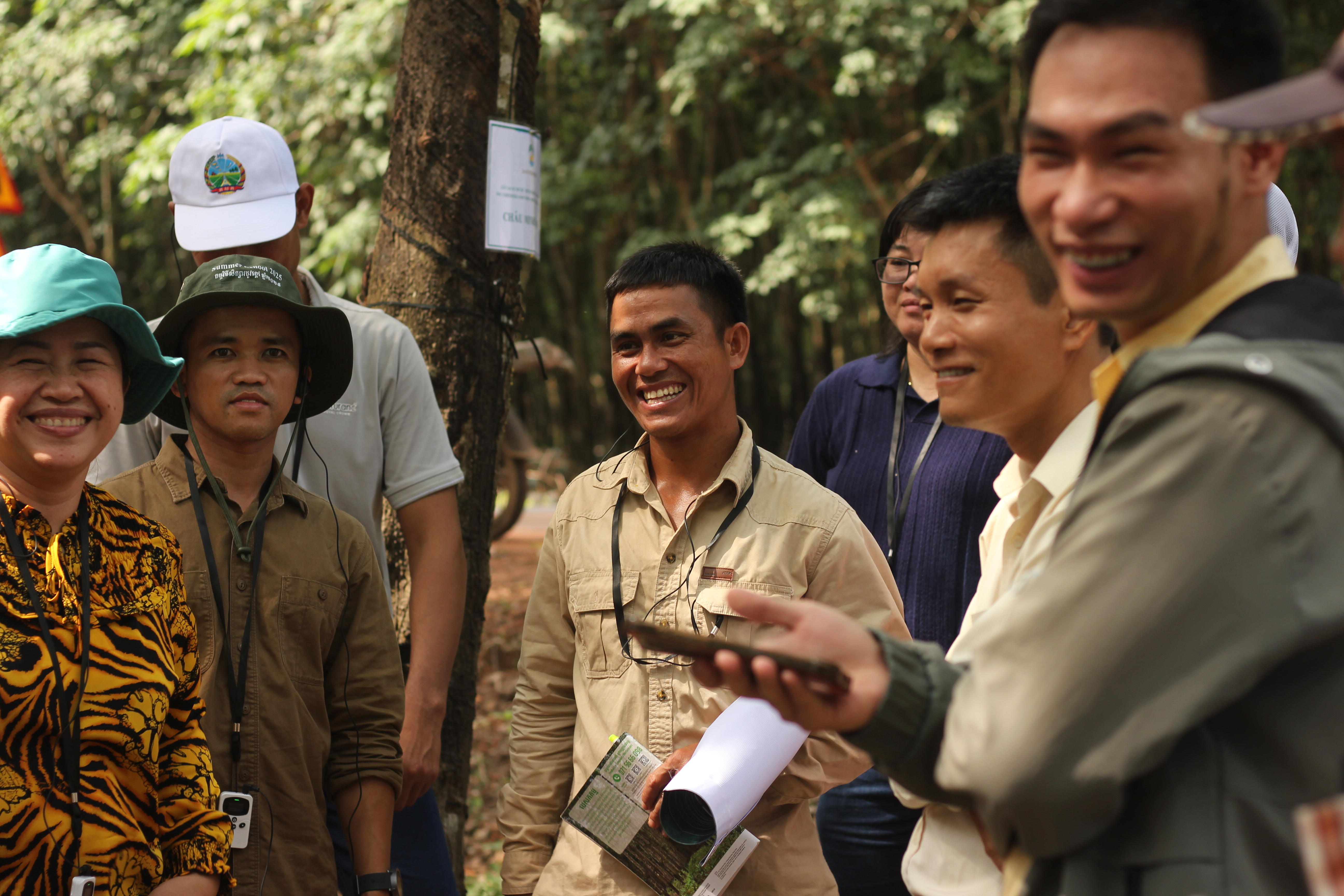
Model “Rubber meets EUDR” of Vietnam is attracting special attention from the Cambodian and Laos rubber industries. During three days from June 18 to 20, 2025, the delegation including representatives of the General Department of Rubber of Cambodia, a number of businesses, smallholders and the Lao Rubber Association conducted a consultation and learning trip in Binh Duong and Binh Phuoc. The program is organized by the Vietnam Rubber Association (VRA) in collaboration with Forest Trends and Oxfam Cambodia. The goal of the consultation trip is to learn about the practical model being implemented in Vietnam, draw lessons and evaluate its applicability in Cambodia and Laos. At the same time, this is also an opportunity for the rubber industries of the three countries to discuss legal issues related to the supply chain and the relationship with forest resources towards sustainable development of the entire industry in the region.


Photos 4,5,6: Delegates visit rubber factories and rubber gardens of smallholder households in Binh Phuoc. Source: Forest Trends
VRA representative, Ms. Phan Tran Hong Van, said: “VRA is committed to accompanying the parties in improving their capacity to meet EUDR and new market requirements. We believe that sharing experiences between producing countries is necessary to achieve sustainable development and supply chain transparency. VRA will continue to promote its role as a bridge, promote regional cooperation and spread pioneering models in the smallholder rubber supply chain.” Appreciating the models and connection support of the parties, Representative of the General Department of Rubber of Cambodia, Ministry of Agriculture, Forestry and Fisheries of Cambodia, Mr. Nhean Sophea, said “Lessons learned from businesses and smallholder rubber farmers in Vietnam in the process of preparing to meet the EUDR are a very valuable reference source for the Cambodian rubber industry. We will study the possibility of applying these lessons into practice in the Cambodian rubber industry.” In addition, Chairman of the Lao Rubber Association, Dr. Bounthong Bouahom, commented “CCollaborative models of large-scale rubber production and smallholder farmers in Vietnam, meeting the EUDR, are worth learning. The Lao Rubber Association is currently coordinating closely with VRA and Forest Trends on supply chain activities. We hope to be able to cooperate in implementing these models in the Lao rubber industry.”

Photo 7: Delegates participating in the consultation and learning trip in Binh Duong and Binh Phuoc. Source: Forest Trends
For further information about this event, please contact Ms. Luong Kim Anh (Email: kanh@forest-trends.org; Phone: 0703014431).
No thoughts shared yet. Be the first to share your thoughts!