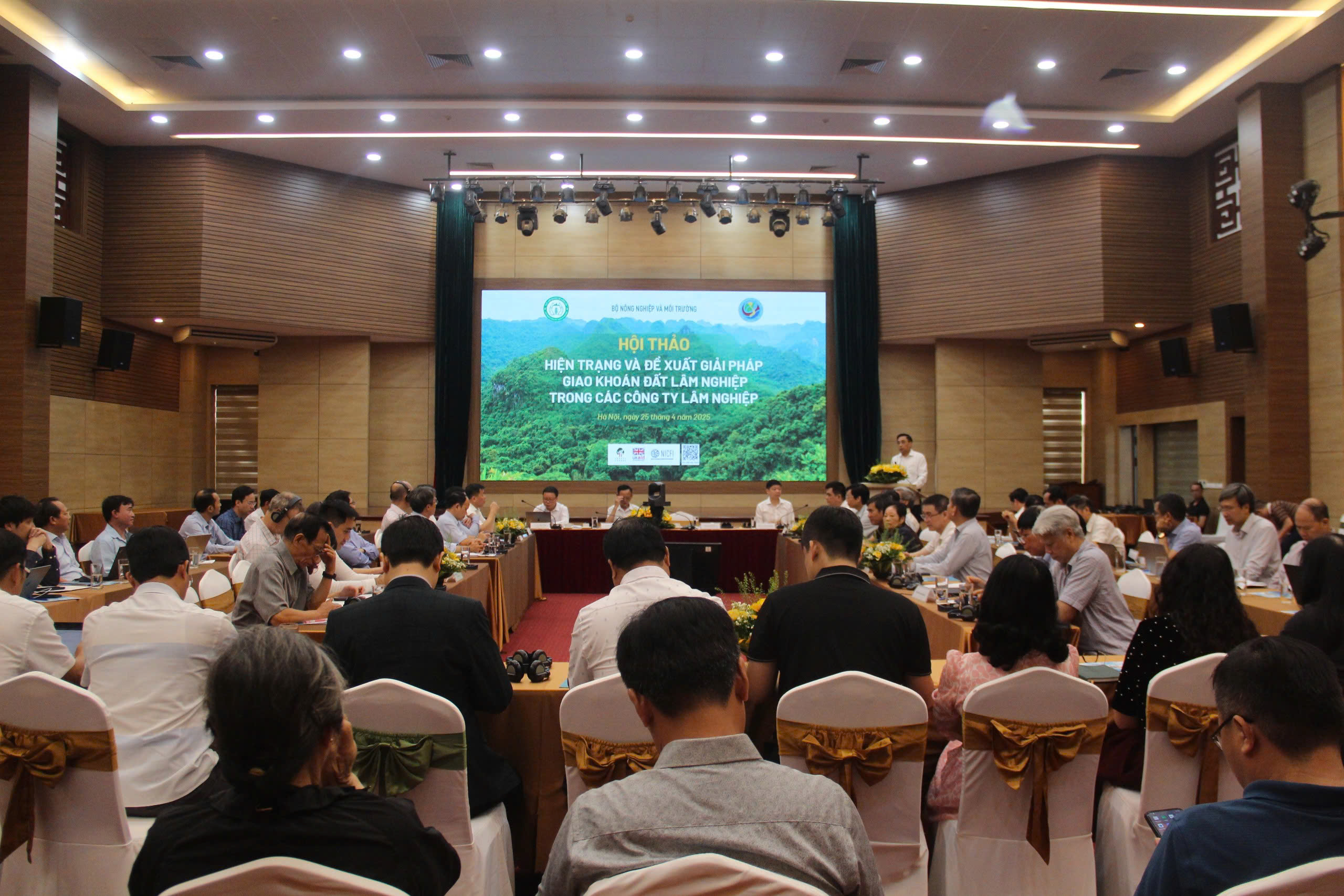

On April 25, 2025, the Association of Agricultural Economic Sciences and Rural Development (VIESARD) and the Department of Forestry and Forest Protection (Ministry of Agriculture and Environment) jointly organized the Workshop "Current situation and proposed solutions for forestry land allocation in forestry companies" in Hanoi. The conference attracted the attention of many domestic and international agencies and organizations. More than 200 delegates participating in person and online shared a lot of information about the current status of the forestry land contract policy, shortcomings and proposed necessary measures to innovate this policy to adapt to important trends of Vietnam and the international community in the integration period.
Photo 1: Leaders of the Ministry of Agriculture and Environment, the Central Policy and Strategy Committee and the Association of Agricultural Economic Sciences and Rural Development co-chaired the workshop with the participation of many local departments and agencies.

Source: Forest Trends
First issued in 1995, the forestry land contract policy in forestry companies has undergone many major reforms in the context of many changes in Vietnam's socio-economic situation and policy framework. Decree 01/CP of 1995 of the Government opened the door for the mechanism of land allocation for agricultural, forestry and aquaculture production in state-owned enterprises. This is an important policy, born with a historic mission to green up bare lands and bare hills and create more livelihoods for people living near forests in a context where the country has just gone through two difficult decades after the war. Local people receive contracted forestry land from state-owned forestry farms for up to 50 years to organize their own production or forest protection, in exchange for money or food support from the state. This form is also known as Contracting 01. In the following period, the Government continued to issue Decree No. 135/2005/ND-CP in 2005 (referred to as Khoan 135) and Decree No. 168/2016/ND-CP in 2016 (referred to as Khoan 168) to reform and strengthen the legality of contracting policy. The contract term is also gradually shortened to less than 20 years, with contracts based on cycles and tasks. Particularly, forest protection contracts are assigned annually. However, during 30 years of implementation, this policy has revealed many shortcomings.
With the support of the Forest Trends organization, the Association of Agricultural Economic Sciences and Rural Development (VIESARD) in collaboration with the Department of Forestry and Forest Protection (Ministry of Agriculture and Environment) and the Department of Sectoral Economics (Central Policy and Strategy Committee) sent a dispatch to survey all forestry companies across the country combined with field surveys in 7 provinces in the first quarter of 2025 to review and evaluate the current status of forestry land allocation. in the NTLNs. Research results will be used to make policy recommendations to propose solutions to organize production and contracting to improve the efficiency of management, land use, sustainable forest resource management, and improve production and business efficiency of SFCs in the coming period.
Photo 2: The contracting policy was born with many important economic and social tasks

Source: VIESARD
From 2005-2012, state-owned forestry farms were arranged and converted into one-member limited liability companies, two-member limited liability companies with 100% state capital, joint stock companies and revenue-generating public service units such as forest management boards, etc., dissolving ineffective forestry farms. On December 17, 2014, the Government issued Decree No. 118/2014/ND-CP on arranging, innovating, developing and improving the operational efficiency of agricultural and forestry companies, which requires forestry companies to carry out the review, measurement, mapping, cadastral records, approval of land use plans in accordance with local planning and land use plans and issuance of use right certificates. land use. In addition, ineffectively used land areas will be allocated to localities for management and use. However, the arrangement of forestry companies is going slowly, especially the arrangement according to the model of establishing a two-member limited liability company, affecting the company's production and business plans and contracting work.
According to the Department of Sectoral Economics, Central Policy and Strategy Committee, forest and forestry land contracting is a major policy of the Party and State with the goal of creating economic incentives to encourage people to participate in forest protection and development. Resolution No. 18 and 19-NQ/TW dated June 16, 2022 of the 13th Party Central Committee clearly stated the state's policy of creating preferential policies to support poor households and ethnic minority households with productive land, create livelihoods, and protect forests. Regarding the contracting policy, the Politburo issued Resolution 28/NQ-TW in 2003, Resolution 30-NQ/TW in 2014 and Conclusion No. 103-KL/TW dated December 2, 2024 on arranging, innovating and developing to improve the operational efficiency of forestry companies, which sets out the task of handling cases where land of SFCs is encroached or disputed for a long time in order to Stabilize the security, social and economic situation in border areas, remote areas. However, in reality, providing solutions to harmonize the interests of the state, businesses and contractors still has many challenges, especially in the context that the management and use of land originating from forestry farms still has many weaknesses, and the forestry land data information system is not synchronized from central to local levels.
The management, preparation and approval of land use plans and putting into operation and use the area of the forestry enterprise handed over to the locality is still slow and faces many difficulties. According to Dr. Nguyen Ba Ngai, out of nearly 380 thousand hectares of land allocated to localities for management and use, more than 120 thousand hectares, equivalent to about 23.6%, are encroached, disputed or duplicated, and have not yet been resolved. The group of land allocated to localities is mainly bare land, bare hills, bad land, eroded land, fragmented due to freedom of encroachment and use, has unclear legality and lacks effective planning and use plans. The state needs to simplify procedures for land allocation from forestry companies to localities and have local support policies to manage and use these land areas more effectively and transparently.
Photo 3: Area of natural forests and planted forests (unit: thousand hectares) allocated to forest owner groups

Source: To Xuan Phuc
According to the report of Dr. To Xuan Phuc, currently the total area contracted by forestry companies to households is over 458,000 hectares with many forms of contracting being applied. Among them, the form of forest protection contract is the most popular with the contracted area in this form accounting for 66% of the total contracted area of companies. The current situation of using land areas contracted to households is very complicated. In many places, people have planted long-term agricultural and industrial crops such as coffee, cassava, pepper, cashew, fruit trees, etc. on assigned forestry land areas. Decree 168 has introduced transitional provisions that allow the company to liquidate the contract and recover the contracted area in case the contracting party does not comply with the contract, uses the contracted area for the wrong purpose or transfers it illegally. However, survey results show that in reality, the implementation of this transitional provision has encountered many difficulties in many localities because Decree 01 and Decree 135 allow contractors to make long-term investments in land, including infrastructure such as drying yards, water tanks, irrigation systems, etc.
Representatives of some forestry companies participating in the workshop also shared that in essence, a contract is an economic contract agreed between a company and a household. Even if the legal framework and contracting policy change, the company must still respect and implement the terms of the contract. Therefore, the contracted areas with a term of up to 50 years that have not yet expired cannot be arbitrarily revoked by the company. On the other hand, in some places, there is a situation where households refuse to liquidate their contracts when the old ones expire or refuse to sign contracts under the new mechanism, leading to land disputes, clashes with company employees, and in some cases, having to invite the police to intervene. The lack of a reasonable compensation mechanism and instructions for liquidating contracts is creating significant barriers for CTLN in managing and using these land areas. This has caused many companies to decide to transfer these disputed areas to local management.
In fact, compared to households with small areas of forestry land, many fragmented land plots and limited investment capital, forestry farms have a huge advantage in applying sustainable forest management, especially forest certification. Currently, SFCs in Vietnam have been granted sustainable forest certification for about 140 thousand hectares, accounting for 27% of the country's certified forest area, even though they only manage more than 300 thousand hectares of planted forests. The harvesting cycle of wood trees in SFCs is also longer than in households with higher levels of applied science and technology, leading to better productivity and quality of wood, giving higher value, in accordance with the state's policy of planting large timber forests. Dr. Ha Cong Tuan - former Deputy Minister of Agriculture and Rural Development in charge of forestry, said that it is necessary to return the contract to its true nature as an economic contract instead of also having a social security function in the previous period. The contracting mechanism should not have rigid regulations but should be seen as a civil economic agreement between the forest owner and the contracting party so that both parties can freely negotiate and agree on economic activities on contracted land to optimize land management and use, enhance economic efficiency and increase budget revenue on forestry land.
Photo 4: Dr. Ha Cong Tuan believes that it is necessary to separate social security functions from contracting policies

Source: Forest Trends
Removing problems with the contracting mechanism for SFCs, especially with disputed and encroached areas, is important as Vietnam is integrating more deeply into the global economy and is governed by forest protection and sustainable development policies of import markets such as the EU Anti-Deforestation Regulations (EUDR). Transparency and legalization of land origin is an important step to meet the requirements for traceability of agricultural and forestry products - a core point in the due diligence requirements of developed markets such as the EU, US, and Japan. On the other hand, in the context that Vietnam is urgently developing carbon market policies, resolving existing problems in the contracting mechanism also helps clarify the rights of forest owners and contractors regarding revenues from forest environmental services, including the function of absorbing carbon emissions, in which forest carbon credits can be considered a type of non-timber forest product. Concluding the workshop, Mr. Tran Quang Bao - Director of the Department of Forestry and Forest Protection - said that the Department will continue to coordinate with the Central Policy and Strategy Committee to continue to receive comments on reform of the contracting mechanism and will propose and advise leaders at all levels of the Party and state to soon resolve remaining problems in the contracting mechanism in the near future.
If you are interested, please refer to the reports presented at the conference at DOCUMENT DOWNLOAD LINK.
No thoughts shared yet. Be the first to share your thoughts!