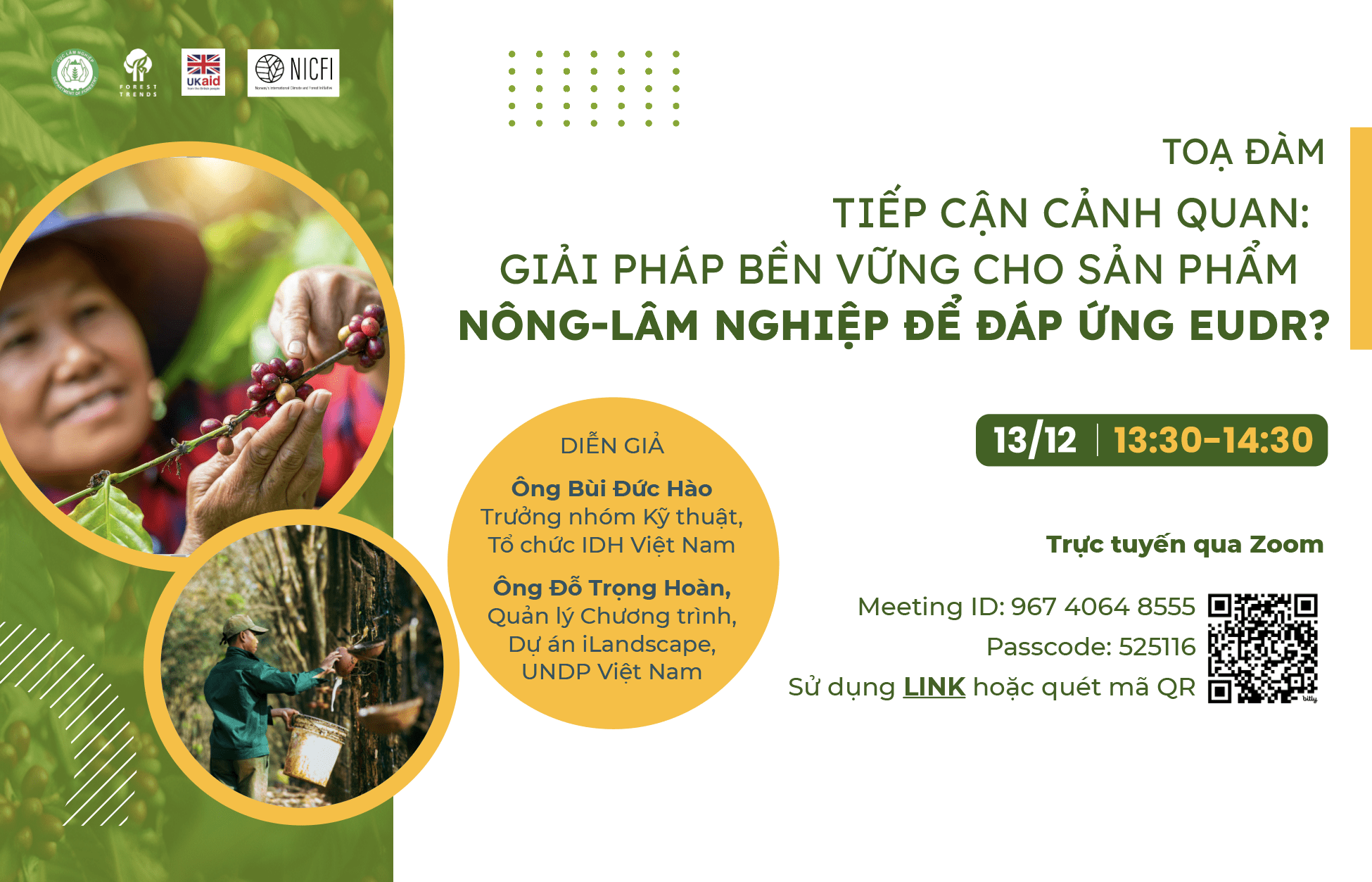
On December 13, 2024, the EUDR-Forestry Network hosted a webinar "Landscape Approach: A Sustainable Solution for Agri-Forestry Products to Meet EUDR Requirements?" Key speakers included Mr. Bùi Đức Hào, Technical Lead at IDH Vietnam, and Mr. Đỗ Trọng Hoàn, Program Manager of the iLandscape Project – UNDP Vietnam. The webinar highlighted ongoing projects by UNDP and IDH Vietnam that apply the landscape approach to promote sustainable development in Đắk Nông and Lâm Đồng provinces.
What is the Landscape Approach?
The landscape approach is a sustainable method for managing land and resources, emphasizing collaboration among stakeholders within a specific region. Its primary goal is to balance economic, social, and environmental benefits, fostering harmony between people and nature. This approach promotes the development of a shared vision, concrete action plans, and long-term partnerships to address complex challenges in resource management effectively.
The landscape approach not only preserves essential ecological functions such as biodiversity conservation and water security but also promotes economic development and improves community livelihoods. By integrating production activities—such as agriculture, resource extraction, and forest conservation—this approach helps resolve conflicts between sectors and enhances transparent, responsible resource governance.
In Vietnam, the Central Highlands serve as a dynamic hub of diverse economic activities, including agriculture (e.g., rubber, coffee, and short-term crops) alongside vital forest conservation initiatives. The landscape approach offers a potential solution to harmonize these objectives, promoting sustainable production while protecting ecosystems, biodiversity, and forest resources.
Key Factors Influencing Landscapes
According to representatives from IDH Vietnam, landscapes are shaped by three main factors: physical elements (natural and human-made), human factors, and natural conditions (e.g., temperature, rainfall). External influences, such as research institutes, banks, export factories, and fertilizer suppliers, also significantly impact landscapes. Additionally, markets, buyers, and consumers play a direct role—when consumers prioritize sustainability, it drives the sustainable development of landscapes and vice versa.
Applying the Landscape Approach in Practice
Currently, UNDP and IDH Vietnam are collaborating with partners to implement projects using a landscape approach to promote sustainable value chain development in the Central Highlands region. One key approach in these activities is establishing PPI compacts (Production-Protection-Inclusive Development Alliances) at the district and provincial levels. PPI compacts involve all producers, stakeholders, landowners, and land users within a geographical area, encompassing key sectors in the region. Through public-private partnerships and multi-stakeholder mechanisms throughout the process of goal setting, design, planning, and intervention implementation, PPI compacts continuously improve the sustainability of the region. The PPI compacts focus on:
- Resource protection and conservation Supporting forest regeneration, agroforestry (intercropping), and water and soil resource protection
- Sustainable production
- Improved livelihoods and social well-being
To date, IDH has established 5 PPI compacts, including 3 in Dak Lak, 2 in Lam Dong, and is working with Dak Nong province to design 2 additional PPI compacts in Dak Nong.
These initiatives have yielded tangible results. For instance, in Di Linh, monoculture coffee cultivation decreased by 90%, and intercropping areas increased to 51% in Di Linh and over 70% in Đắk Lắk. Irrigation efficiency for 20% of coffee farms in Di Linh also improved, mitigating drought impacts despite similar temperature and rainfall conditions to past droughts in 2014 and 2023.
The Landscape Approach and EUDR Compliance
The landscape approach emphasizes multi-stakeholder collaboration, with an indispensable role played by government agencies such as provincial/district People's Committees and functional bodies under the Ministry of Agriculture and Rural Development, including the Department of Forestry and the Forest Protection Department. These government agencies are responsible for developing, managing, and providing forest databases and current forest boundary data to stakeholders, including businesses and local communities. Within PPI compacts, the Department of Forestry and the Forest Protection Department provide data platforms that enable stakeholders to create standardized planting area databases, avoiding overlaps and reducing costs for producers.
The landscape approach also fosters collaboration across supply chain actors, facilitating traceability within supply chains. By promoting multi-stakeholder participation, the approach positions stakeholders as both active contributors within the landscape and monitors of legal compliance and planned activities. This ensures fairness and transparency in production activities and adherence to regulatory frameworks.
Please review webinar documents at the link and watch the full webinar recording below:
If you have any questions or feedback, please do not hesitate to contact us at: hathuckpt@gmail.com
No thoughts shared yet. Be the first to share your thoughts!