On November 15, 2024, the Laos Rubber Association, in collaboration with the Vietnam Rubber Association, Forest Trends, Oxfam Cambodia, and the Global Environmental Institute of China, organized a workshop: "Promoting Sustainable Natural Rubber Production, Trade, and Investment in Mainland Southeast Asia." The workshop took place in the context of major rubber-consuming countries such as the United States and the European Union developing and preparing to implement legislation aimed at sustainable and deforestation-free products, including rubber.
A complex supply chain with diverse range of stakeholders
The rubber industry in the region is characterized by a diverse range of stakeholders participating in the supply chain. These include state-owned enterprises, private companies, foreign-invested firms, domestic and concession plantations, intermediaries such as agents and collectors, and smallholder farmers. This intricate network results in a highly fragmented and complex supply chain. A significant challenge lies in the limited access to market information for smallholder farmers and purchasing agents, leaving them ill-equipped to meet international market standards. Moreover, the frequent mixing of raw materials from various sources, including the blending of rubber from large-scale plantations with that from smallholders, further complicates efforts to ensure consistency and compliance across the supply chain.
In addition to domestic sources, most countries in the Mekong region also rely on imported rubber. Without an accountability system to track the flow of raw material inputs, there is a high likelihood that imported rubber may be mixed with domestic rubber, making it impossible to trace its origin.
Smallholder rubber producers face significant challenges in meeting the requirements of the EUDR
According to insights shared by speakers at the workshop, a common characteristic of the rubber sector in Southeast Asia is the high proportion of smallholder rubber plantations, characterized by fragmented and small-scale production. Smallholder rubber accounts for 98% of the total plantation area in Myanmar, 44% in Cambodia, 30% in Laos, and approximately 50% in Vietnam. Unlike state-owned enterprises, which operate large rubber estates with comprehensive legal documentation and readily traceable supply chains, smallholder rubber faces significant challenges in meeting the new requirements of the EUDR. Firstly, the EUDR mandates traceability down to the individual plot level. However, smallholder farmers typically lack the habit of recording and storing information during harvesting, making traceability difficult. Additionally, the small size of these plantations — for instance, 66% of smallholder rubber farms in Vietnam are under 3 hectares — creates a massive volume of geolocation data and documentation that needs to be collected, significantly increasing compliance costs for businesses.
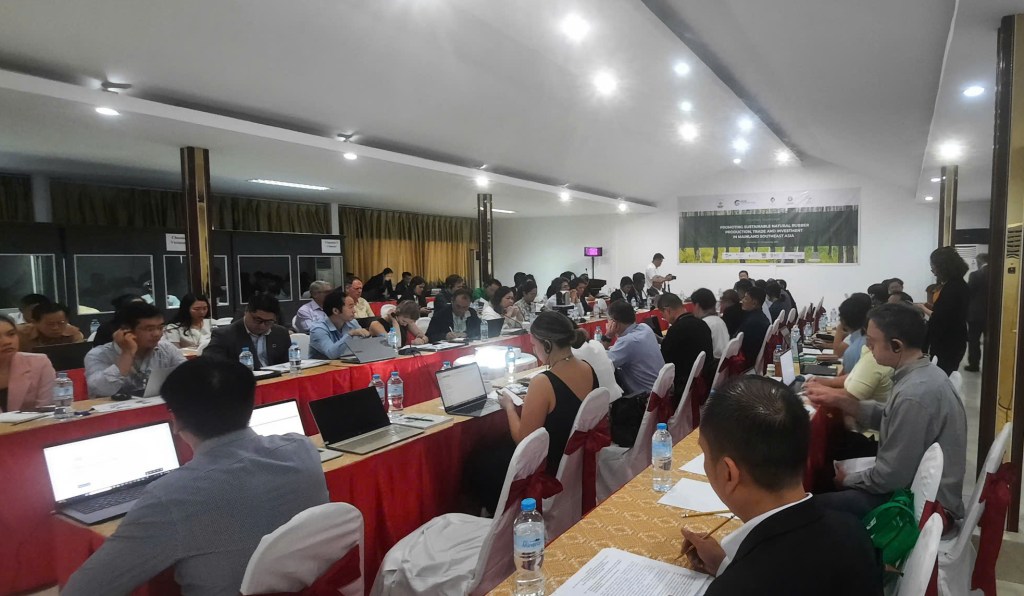
Overview of the workshop. Source: Forest Trends
Some Issues Regarding the Legality of Rubber
In addition to the traceability requirements mandated by the EUDR, the rubber sector in Southeast Asia faces the issue of rubber latex theft. According to accounts from some rubber enterprises in Laos, approximately 20% of their latex is stolen, with most of it being exported due to higher prices offered abroad compared to the domestic market. This presents a significant legal risk for Vietnamese companies that rely on imported rubber for production, as the stolen latex can compromise the legality of their supply chains.
Additionally, land origin is another critical issue to address. In Southeast Asia, there are many rubber concessions, such as in Cambodia, where large areas may have been reclaimed from indigenous peoples' ancestral land without obtaining Free, Prior, and Informed Consent (FPIC) from the local communities before transferring the land to companies. Furthermore, deforestation for rubber cultivation has been a long-standing issue, especially before 2012, when global rubber prices peaked. As a result, businesses may face legal challenges related to indigenous land rights or the legitimacy of rubber plantation land.
Solutions for the Rubber Industry in Southeast Asia
Firstly, there is a need to enhance the general understanding of the rubber supply chain in the region. To meet the increasingly stringent requirements of international markets, Southeast Asia's rubber industry must develop specific solutions to build a transparent and legal supply chain. Countries with significant import-export activities, such as China, Vietnam, Laos, and Cambodia, need to strengthen customs data sharing and exchanges to identify illegal supply flows and implement timely corrective measures. Additionally, more research is needed on the current state of the supply chain and its existing challenges, providing a foundation for future policy discussions among governments, businesses, and stakeholders.
Secondly, multi-stakeholder dialogue platforms are essential to allow actors within the supply chain to connect, share information, and learn from each other’s experiences. Through these forums, joint technical working groups can play a pivotal role in facilitating multilateral discussions to identify solutions and mobilize the necessary resources to address the common challenges facing the rubber industry in the region.
Thirdly, stakeholders can learn from the experiences of pioneering businesses and organizations and apply pilot projects in regions or among groups that face significant challenges in meeting new international supply chain requirements. The results of these pilot projects can serve as valuable input for policy development and guide future scaling efforts.
Fourthly, more support activities are needed for smallholder rubber farmers. Due to limited financial, technical, and human resources, smallholders are significantly less competitive than large rubber plantation businesses. Many speakers expressed concern that smallholder rubber could be excluded from supply chains in markets such as the EU or the US. Therefore, technical and financial support is essential to ensure equitable market access for smallholder rubber farmers. The webinar marked an important starting point for future collaborative efforts to support the rubber industry among Mekong region countries. Future forums are planned for 2025 to continue discussions and seek solutions for building a sustainable and legal rubber supply chain in Southeast Asia.
Please review webinar documents at the link
No thoughts shared yet. Be the first to share your thoughts!