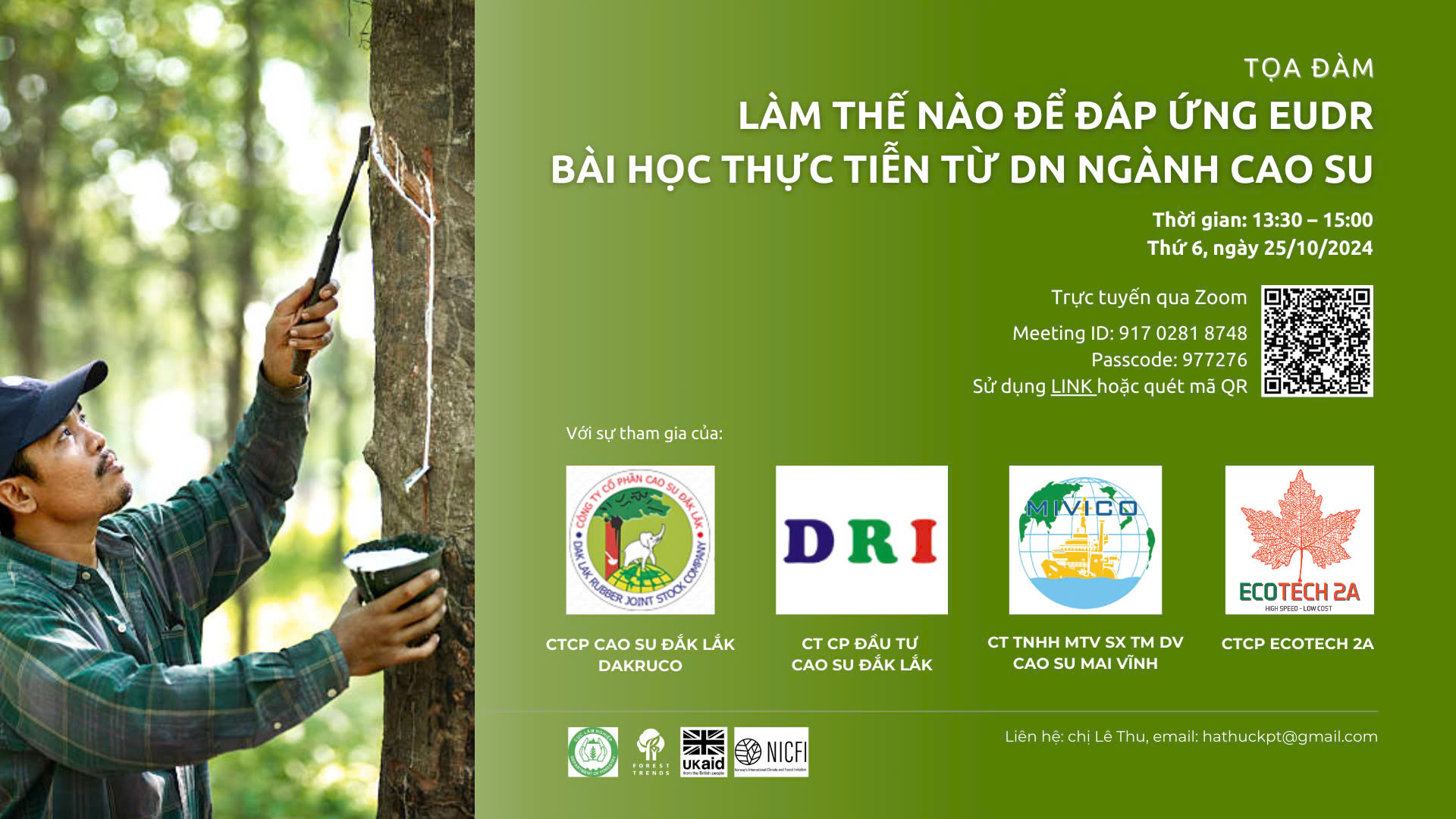
On the afternoon of October 25, 2024, the EUDR – Forestry Network organized an online seminar How to comply with EUDR – Practical lessons from theThe participants in the seminar were given insights by Dak Lak Rubber Joint Stock Company (DAKRUCO), Dak Lak Rubber Investment Company (DRI), and Mai Vinh Rubber Company (MAVICO) about their efforts to adapt to the requirements of the EUDR. These three companies represent three models of the industry's supply chain: (i) large plantations with sustainability certifications, (ii) large plantations without sustainability certifications, and (iii) smallholder plantations with sustainability certifications.
Large-scale rubber plantations and traceability
Large-scale rubber plantations, which are mainly concentrated in companies, enterprises, and state-owned farms, have large areas, clear land use certificates, and certified rubber gardens with no disputes. This makes it easier to meet legal requirements and ensure traceability. Additionally, as businesses or companies with financial and human resources, large-scale rubber plantations can establish traceability systems at every step— from field teams, work sites, and factories. This enables them to collect and store records, which can be provided to European importers for verification and compliance with regulations.
Quality standards and sustainability certifications
According to representatives from DAKRUCO and DRI, a company that complies with quality and environmental management systems such as ISO:9000 and ISO:14000 will have an advantage in meeting the EUDR, as these standards already include templates for supply chain management and traceability. Additionally, they demonstrate the company's commitments and actions in protecting and managing environmental quality throughout the production chain. Besides using templates from these quality management systems, the companies also develop their own templates based on the requirements and advice from customers, as well as the regulations of EU customs authorities.
Currently, both DAKRUCO and DRI have been granted FSC certification, allowing them to quickly meet the EUDR requirements. According to DAKRUCO's assessment, complying with the 10 principles of the FSC standards has helped the company fulfill 90% of the EUDR requirements. However, the company also noted that it has only received FSC certification for large-scale rubber plantations and is currently assisting smallholder farmers in controlling the traceability of rubber from their plantations.
Smallholder rubber plantations and their weaknesses in meeting EUDR requirements
At the seminar, MAVICO shared that the company currently purchases rubber from 300 smallholder farms, covering a total area of approximately 5,000 hectares. To meet the requirements of European importers, MAVICO must conduct training for smallholder farmers on the EUDR, then collect their documentation, including land use rights and information about the plantation owners. Additionally, the company collects and builds a database of the coordinates of the rubber gardens. Based on the collected records, the company evaluates the ability of the rubber gardens to meet EUDR requirements.
For smallholder rubber plantations, the biggest challenge is controlling the rubber supply chain to ensure the raw materials are not mixed. Additionally, due to the family-scale cultivation and harvesting, smallholder rubber farms also face challenges in complying with regulations related to the environment, chemical safety, and the prohibition of child labor, etc.
In addition to actions aimed at meeting EUDR requirements for rubber businesses, the seminar participants also expressed concern about verifying land legality, particularly for smallholder farms without land use certificates (red books). A representative from MAVICO stated that documents such as lease agreements or land rental contracts can also serve as proof of land legality. Land plots without legal land use documentation have not yet been verified and are not included in the supply chain for the EU market.
The full recording of the event can be viewed in the video below.
If you have any questions or feedback, please do not hesitate to contact us at: hathuckpt@gmail.com
No thoughts shared yet. Be the first to share your thoughts!