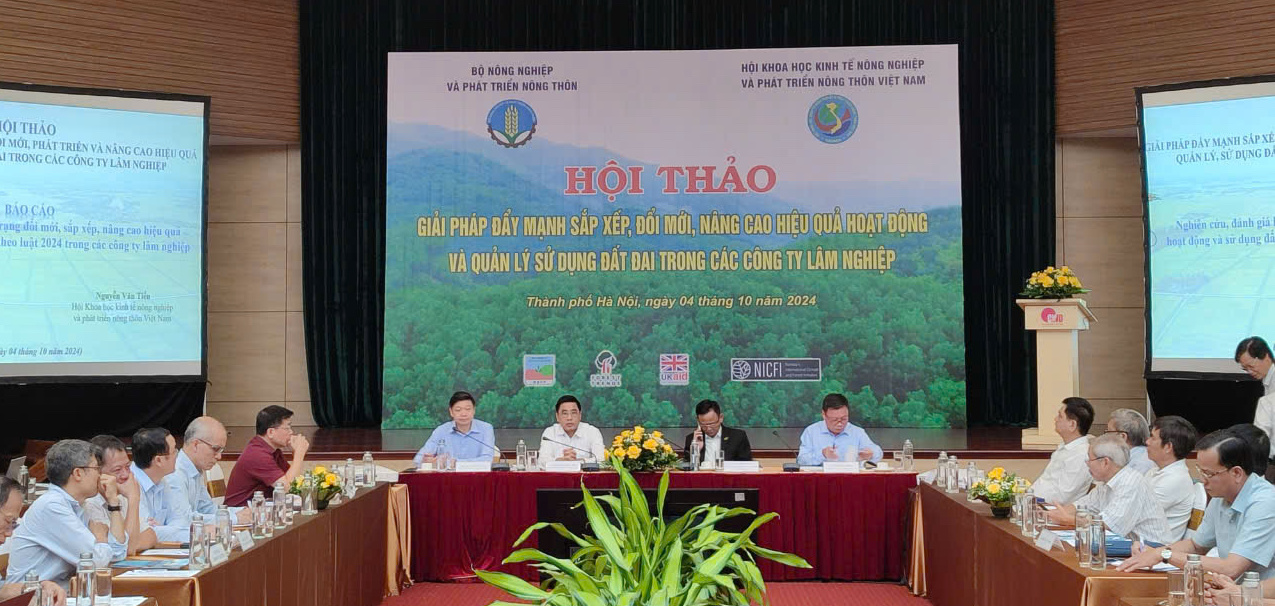
Hà Nội, October 4, 2024 – The Department of Forestry (Ministry of Agriculture and Rural Development) in collaboration with the Vietnam Forestry Science and Economics Association organized the Workshop on “Solutions for Strengthening the Restructuring, Innovation, and Improving the Effectiveness of Operations and Land Management in Forestry Enterprises”, with sponsorship from Forest Trends and UK PACT.
In Vietnam, forestry companies, which originated from state-owned forestry enterprises, were established after 1955 with the goal of contributing to the country's socio-economic development. Through various stages of land policy changes and forest protection and development from 2003 to 2014, the Politburo issued Resolution 28-NQ/TW on the continued restructuring, innovation, and development of state-owned forestry enterprises, as well as Resolution 30-NQ/TW on further restructuring, innovation, and development to enhance the effectiveness of forestry companies. In these resolutions, the management of forestry activities, land resources, and forest resources must be transformed and their effectiveness improved.
After more than 20 years of implementing the policy, some forestry companies have achieved effective business operations, creating jobs for workers, including ethnic minorities in border areas, remote, and disadvantaged regions, contributing to political-social stability and the development of agriculture, farmers, and rural areas. These forestry companies have played a role in the development of economic timber plantations, forest product processing, participating in the sustainable wood industry's value chain, promoting forest contracting, and contributing to the protection of natural forests.
Although receiving attention from both central and local authorities, the restructuring of forestry companies has been slow. As of September 2024, 54 out of 169 (32%) forestry companies had not yet completed their restructuring. After the restructuring, the forestry companies and forest management boards oversee approximately 1.48 million hectares of forest and forest land, mainly consisting of production forests. Despite the large area of land managed by these companies, the land management efficiency of most forestry companies remains low, with weak forest protection and a significant amount of unused barren land. Land reviews are primarily carried out on paper rather than in the field, and boundary markers and land measurements have not been properly carried out. Land management practices are lax, with many of the converted forestry companies failing to complete the required procedures for land transfer or lease according to the Land Law. In many localities, the issuance of land use certificates for forestry companies is delayed, and land disputes remain prolonged and complex.
Please access seminar documents at link.
No thoughts shared yet. Be the first to share your thoughts!