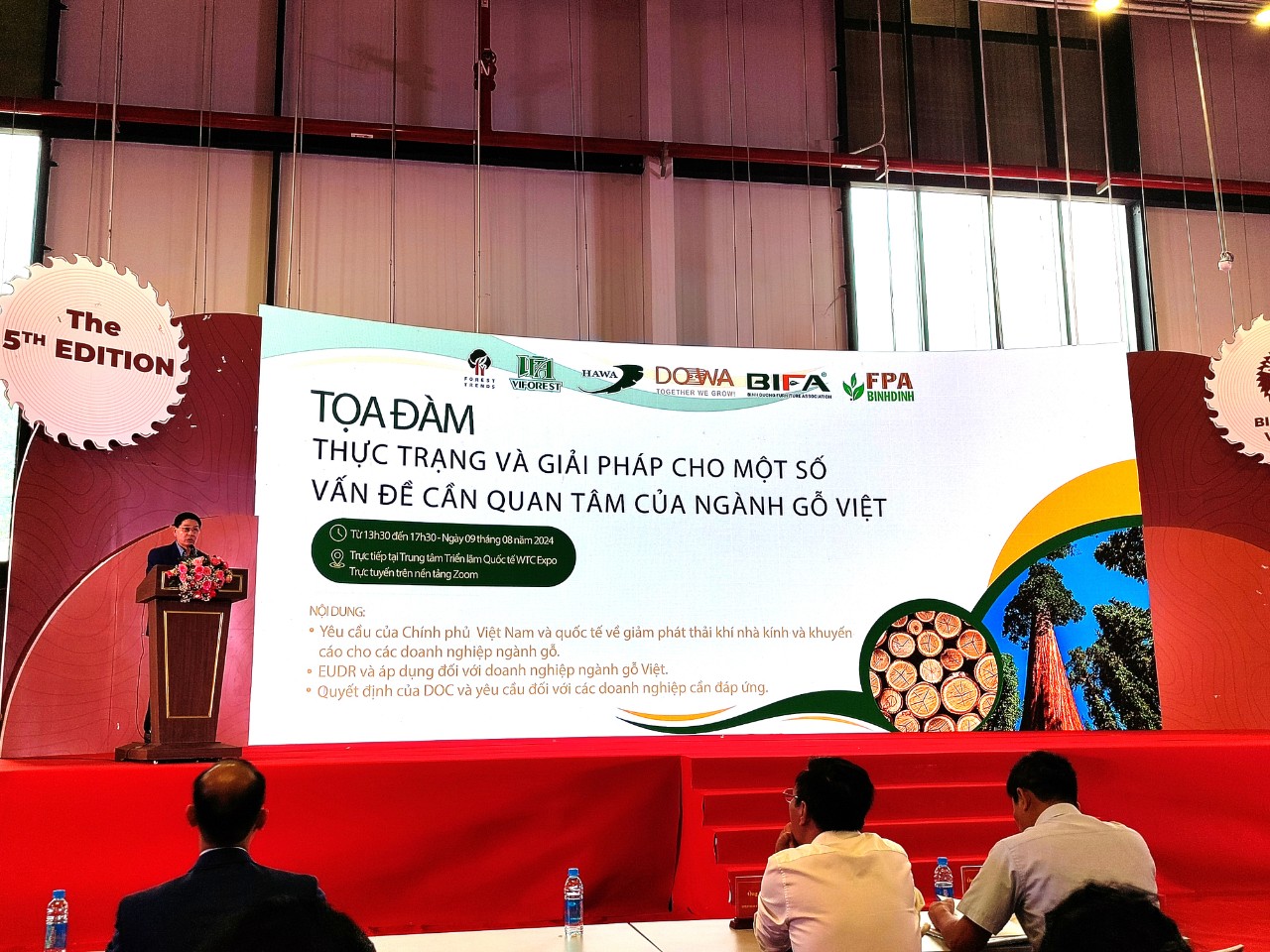
Mr. Đỗ Xuân Lập, Chairman of the Vietnam Timber and Forest Products Association, delivered the opening speech at the seminar
Bình Dương – On the afternoon of August 9, 2024, at the WTC Expo Binh Duong International Exhibition Center, the Vietnam Timber and Forest Products Association, in cooperation with Forest Trends, organized a Seminar titled “The Current Situation and Solutions for Key Issues Facing Vietnam's Wood Industry”.
The session was divided into two discussion session. Session 1 focused on greenhouse gas (GHG) inventory activities in wood industry enterprises. Presentations and discussions in this session emphasized the requirements set by the Vietnamese government and international organizations regarding the reduction of greenhouse gas emissions and recommendations for wood enterprises. Session 2 was dedicated to sharing insights from associations and business representatives on preparing to meet the requirements of the EU Deforestation Regulation (EUDR) and the U.S. Department of Commerce (DOC) decisions.
During Session 1, three experts in the field of emissions measurement and reduction consulting, including Mr. Nguyen Phuong Nam – CEO of KLINOVA Consulting Company, Ms. Thai Le Bao Ngan – Supply Chain Director at LEANWARES Joint Stock Company, and Ms. Nguyen Truyen – Independent Expert, introduced the legal framework related to GHG inventory activities. The Vietnamese government committed to achieving net-zero emissions by 2050 at COP26 and has issued a series of related decrees and circulars to fulfill this commitment. As part of this, GHG inventory will become mandatory for enterprises in six sectors (energy, transportation, construction, industrial processes, agriculture-forestry-land use, and waste) in Vietnam.
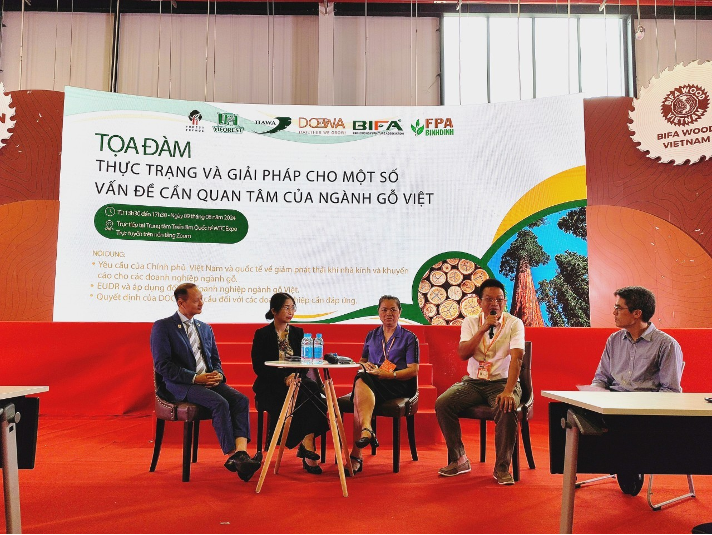
Representatives from Lâm Việt Company and other speakers shared their experiences in measuring and reducing greenhouse gas emissions with businesses in the timber industry.
Therefore, businesses need to take proactive steps in gathering information, collecting data, conducting risk assessments, and planning scenarios, as well as developing strategies to reduce greenhouse gas emissions. They should invest in innovation and technology, actively participate in carbon offset projects, and engage in industrial cooperation initiatives. The development of the economy in a green, circular direction, in compliance with ESG (environmental, social, and governance) standards, has become an inevitable trend in global business activities. Implementing measures to measure and reduce greenhouse gas emissions not only helps businesses comply with legal regulations but also brings economic benefits by reducing production and operational costs, while enhancing the company's position and brand value in international markets. Currently, Forest Trends is implementing a program to support some pioneering enterprises in the wood industry in carrying out these activities, with the goal of sharing experiences widely with other businesses in the near future.
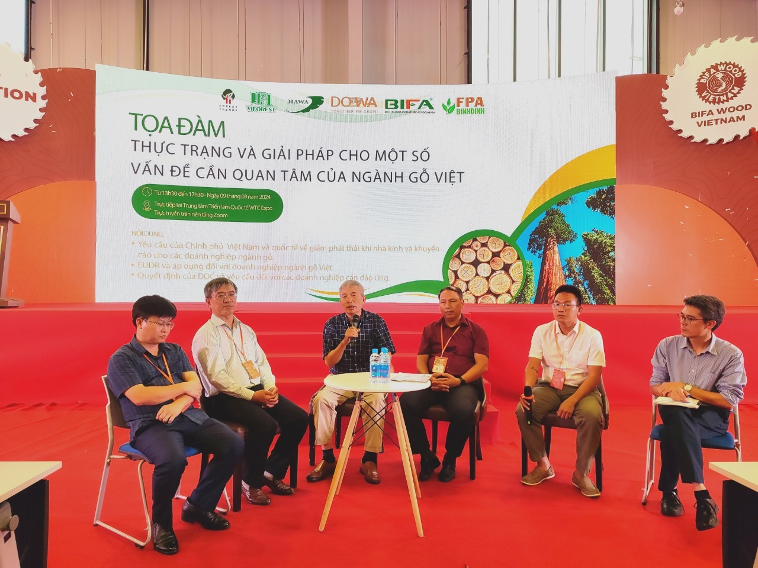
Representatives from regulatory agencies, businesses, and associations shared their experiences in adapting to the EUDR and DOC
In the next discussion session, Mr. Nguyen Hoang Tiep, Deputy Director of the Forest Certification Office (VFCO), shared the similarities between the national forest certification system VFCS/PEFC, PEFC CoC, and the EU Deforestation Regulation (EUDR) in terms of economic, social, and environmental aspects. Specifically, the EUDR stipulates that products must not be made from materials causing deforestation or forest degradation after December 31, 2020. The production process must comply with the laws of the producing country, and there must be geolocation information for the harvested lots as well as a due diligence system to demonstrate compliance with the local legal regulations (such as land legality, legal entity status, production permits, and environmental protection). Meanwhile, the National Forest Certification System, established by the Ministry of Agriculture and Rural Development in 2019 based on Decision No. 1288/QD-TTg of the Prime Minister in 2018, has two main standards for production: the VFCS/PEFC sustainable forest management standard and the PEFC CoC chain of custody standard. Therefore, based on Vietnam's practical conditions, wood products certified under VFCS/PEFC FM will meet some of the EUDR's requirements related to compliance with local laws for production. As a result, businesses implementing the EUDR need to integrate these EUDR requirements into their due diligence systems (DDS), which will allow them to meet EUDR compliance. Currently, PEFC has added the "PEFC Due Diligence System Requirements for the Production of Deforestation-Free Products" (PEFC EUDR DDS) module to the evaluation criteria.
Regarding the investigation into the scope of products and anti-dumping/countervailing duty evasion with wooden cabinets imported from Vietnam, the Department of Trade Remedies under the Ministry of Industry and Trade informed that the U.S. Department of Commerce (DOC) had issued its final conclusion. According to the Department of Trade Remedies, for shipments exported to the U.S. between November 4, 2021, and July 17, 2024, businesses have 90 days to apply the Self-Certification Mechanism (Certificate Regime) for wooden cabinets imported from Vietnam. For shipments between July 17, 2014, and August 31, 2024, businesses may confirm after the shipment has been dispatched, but the confirmation must occur before August 31, 2024. This mechanism allows Vietnamese wooden cabinet exporters to be excluded from anti-dumping/countervailing duties when exporting to the U.S.
The full recording of the event can be viewed in the video below.
The conference materials are available for your reference at link or QR code

No thoughts shared yet. Be the first to share your thoughts!